Where to start….

It’s been 2 months since I last blogged – and there are several reasons for this, but the main one was that I didn’t know where to start. The expected SEND white paper was delayed, the UK government want to introduce more testing, the US government claimed that Tylenol/paracetamol taken in pregnancy could cause autism, the IFS green budget had some very ‘interesting’ opinions on how to solve the SEND crisis, some Reform party members & councillors were criticising the SEND budget (but a local council has also spent £75,000 on union flags to be hung around the county), and then, more recently, there were bits in the autumn budget that makes me very worried about SEND funding, and finally, Wes Streeting, the Health Secretary has started a review into ADHD and ASD because they might be overdiagnosed, which then lead to a BBC GP survey where, apparently, many of them have said that ‘life being stressful is not an illness’ (link here) and that mental health conditions are being over diagnosed. Just when I thought, right, I’ve enough to blog about, something else pops up on my news feed and I then spend several days ranting at anyone who’ll listen, and I don’t actually start blogging.

This is obviously more than one blog, so today I’ll start with ASD, ADHD, diagnosis and causes. I wrote about the genetic roots of ASD & ADHD (link here if you want to read it). While there are some arguments that early life trauma can cause or trigger neurodivergent conditions, this could be an epigenetic trigger, where there is the genetic coding for a condition, but it can also be that trauma almost ‘switches on’ the genes and then the condition is more noticeable. However, sometimes trauma does not switch on genes, but instead, the impact on the body is so great that the external characteristics appear like ASD, ADHD, or PDA, but are a reaction to the trauma. In addition, some conditions, such as MS, can impact cognition in a similar way to dyslexia, but that doesn’t mean that MS causes or triggers dyslexia.

We are not in the middle of a neurodivergent epidemic. I didn’t suddenly catch ADHD in the last few years – the signs have been there since I was tiny, but ADHD was barely recognised in the 1980’s, and even less so in girls, so I was missed. I was also academic, got things done (often at the last minute). Nobody seemed that surprised when my GCSE and then A-level results weren’t near my predicted grades as I was always daydreaming, but if I were a child now, plucking feather duvets, not getting school work done on time, not concentrating in class, being messy, always forgetting where I put things, having a large gap between my reading and spoken language and my written language, the school, or my parents, may have flagged this. I may have had an assessment much, much younger.

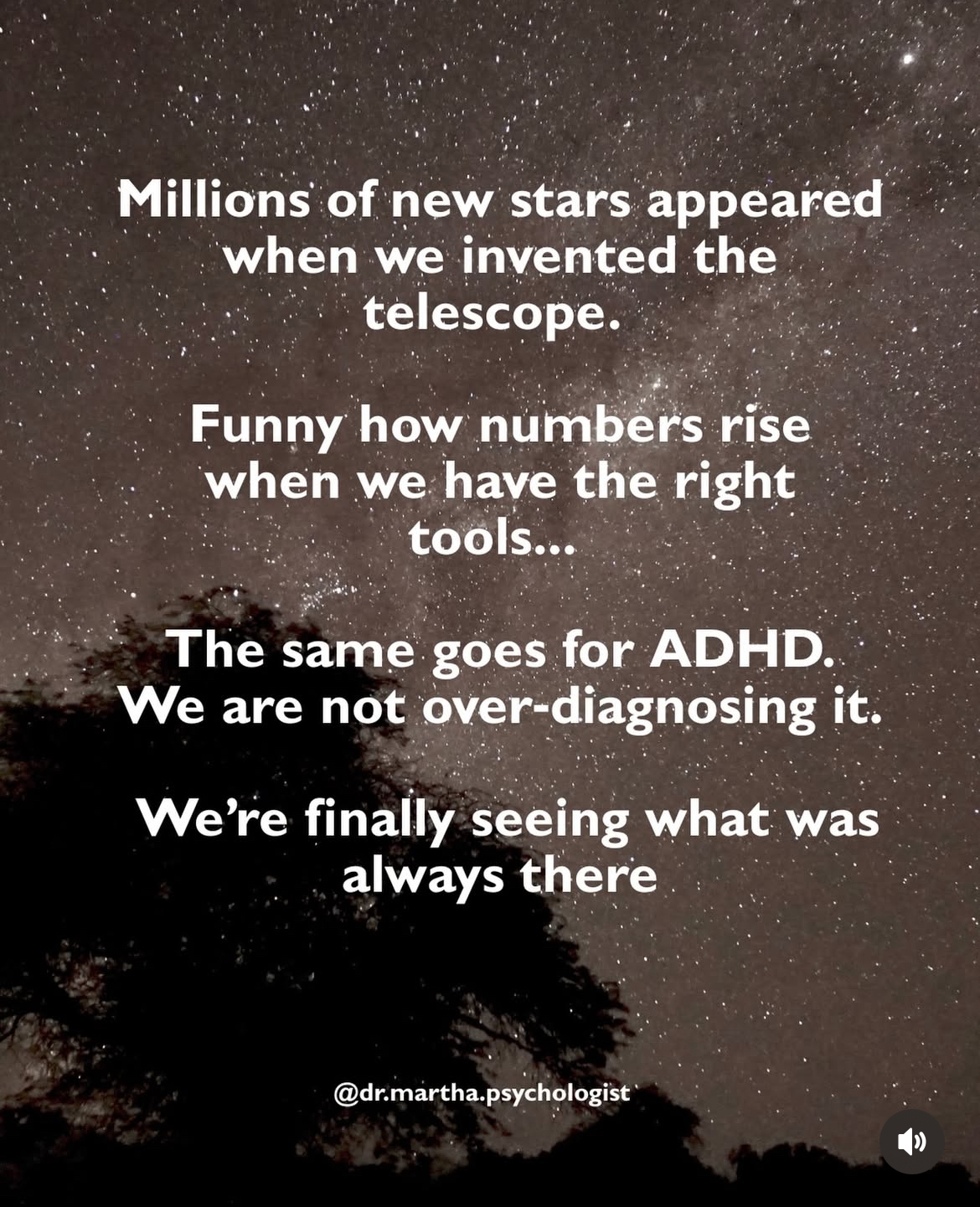
There is a lovely meme on social media at the moment that I have borrowed from Dr Martha Deiros Collado on Instagram (link here) and I think it sums all this up perfectly.
The only other topic I am going to cover today is the debunked link between paracetamol/Tylenol use and autism. The amount of parental guilt when you see your children struggling with life is HUGE. I have spent so many nights wondering what I did wrong. Was it that glass of wine I had before I knew I was pregnant? Was it my stressful job (I found out I was pregnant with our youngest just after an Ofsted inspection)? Was it the fact that all I could eat was salad and chips, and all I could drink was red-bush tea and lemonade? Was it because I worked as an assistant vet nurse, and although I was really careful not to go near anything that may cause any harm to my growing baby, I maybe should have found a different job?

No, no, no, no. Absolutely not. I did not do anything to cause my children’s neurodivergent conditions. Although as parents we have made some decisions that, looking back, could have been better, we did a pretty decent job – and still are. I took paracetamol during pregnancy when I wasn’t well because it was the safest painkiller. I have friends who were on different medications that they needed to take for their own health, and they did nothing wrong either. There have been numerous peer-reviewed studies and meta-analyses that have shown NO link between paracetamol and autism. Paracetamol does not cause autism. We are not in the middle of an epidemic; we are just finally seeing the stars.

Holidays

This isn’t the post I was planning to write today – it was supposed to be a follow up blog about GCSE results that was going to be very similar to my A-level blog last week, but sometimes you just have to go where the words take you, and today, they have taken me to holidays. I am writing this on the Sunday of the Bank Holiday weekend, but I will publish this once we’re on our way home.

Until this year, we have managed to have 2 holidays in the UK each summer – which makes us very lucky. I used to work in Further Education, and the college I worked at broke up for the summer at the end of June/beginning of July. Our children had scholarships to a local private school (again, the fact that we found the money for this even with the help of scholarships makes us very fortunate), so they broke up at the beginning of July. This meant that we could get away for 2 weeks before state schools broke up, when the prices were a little cheaper, especially when we headed to Cornwall. Then, in August, we went away with my parents for a week, usually to Norfolk and we shared the cost, and we also shared the childcare which was a huge thing when our children were younger.

This has continued every year for the last 15+ years, but the teaching job I have now follows school holidays, so because my contract is term time only, we’ve had to stop going away in July. This year, I decided that we would come to Cornwall for 2 weeks – and our second week would be the bank holiday week (I’m sitting writing this in our holiday home). We would come down for 2 weeks, with my parents joining us for the second week, so it was like a hybrid of the holidays we’ve had until this year.

We are having a lovely time – we’ve been to the beaches, but have behaved like locals (I grew up in Poole, Dorset so know how to avoid holiday makers in the summer) and got to the beach early and left when everyone else arrived. We’ve been to our favourite eateries, but have booked tables or got there early to avoid too many crowds, and have been to Newquay and Padstow, but, again, have got there early. It’s been a lovely holiday, and apart from missing the dogs and the cats, I’m in no rush to get home.

However, it is busy. We tried to eat at one of our favourites, and the restaurant was fully booked, even though we had got there late afternoon/early evening, but we could eat at the bar. The first table away from everyone smelt of bins, the second was next to where the band was setting up, and the third was under the speaker with uncomfortable seats. We left and found a plan B that was just as busy, but had outdoor seats. We ordered food (pizzas), had a drink and we left to eat at our holiday home.

This afternoon, our youngest has chatted to me. It’s too busy for him, and he’s also realised that 2 weeks is too long for him. We’ve already booked to come back at Easter, but because he talked to me, we already have a plan. He’s not a child any more, he’s a young adult who is happy catching trains, so at Easter, he will either come with us and train home early, or train down a few days after we arrived and stay til we come home. Problem solved. This holiday, though, he’s stuck with us til we come home on Thursday.

Has this conversation stifled or impacted our holiday? Absolutely not. Has the further revelation before I started writing that he’s spent a lot of time masking this holiday when we’ve been out, so is feeling tired and headachey impacted it? Maybe a little bit, but it’s his holiday too, so I need to be aware of how he’s feeling, and I need to make sure that I do everything I can to help him not to be in too many places where he has to mask. We have talked, and we have a plan.

Looking back, 14 days in a very busy part of Cornwall over the bank holiday weekend wasn’t one of my better ideas, but we live and learn. I’m not perfect, I make decisions that maybe I shouldn’t have done, but I made them with the best intentions. What we can do, is make sure we all have fun on the few days we have left down here. I won’t try and persuade our youngest to come to the beach or go anywhere where he’ll have to mask, and I won’t do that to our eldest either. We may all have to compromise a little bit, but not when it comes to their sensory needs. No compromise there.

We have a day out planned, we know where we’re eating if we’re eating out, and we know that we can all enjoy the next 4 days with minimal masking. I need to breathe, not feel any blame, and know it’s one of those situations that we learn from, and then move on.

For now, I’ve checked the weather so tomorrow is going to be a beach/chill at the house/read kind of day, Tuesday isn’t as good, but we’re off out for the day, and Wednesday will be a quite day with some walks before frantic cleaning and packing as we head back home on Thursday, hoping to avoid the ‘last weekend before the schools go back’ travel chaos on Friday and Saturday.

Results day(s)

In England, Wales and Northern Ireland, many 15-18 year olds will be on edge. The last 11+ years have all led to the moment when they open the email or go to school or log onto a portal. In that moment when they look at their results, they will know if they have been a success or a failure in education……..

Except, in the real work, that’s not how it works and that’s not how it ends. Headlines in the press and on social media about A-level and then GCSE results being up or down, about a north/south/east/west divide and how girls or boys have been better or worse this year are there to make us believe that this is it. Whatever those results, they will follow us and haunt us for the rest of our lives – but they won’t.

Education is becoming more and more monetised. A Government document released earlier in July this year is titled ‘Key Stage 2 attainment and lifetime earnings’ (link here) and in it, the levels in KS2 SATs are linked to what that 11 year old may earn in their lifetime. What a load of rubbish, and how awful to have a report that looks at SATs results and how much tax these CHILDREN may pay in their lifetimes. Nothing about happiness, health, mental well being or anything important, just their potential lifetime earnings. There will be similar research out there for GCSE/level 2 results and A-level/level 3 results, and these obviously will include Scottish Nationals and Highers.

Young people’s exam results matter – I am not saying they don’t. What happens over the next year or two will be directly influenced by their results. University, apprenticeships, work, college places may all depend on the numbers of A, B Cs and 9-4s, but life does go on if the required grades don’t appear on the results slip.

What we need to do as we approach results days (and apologies to any readers in Scotland, this is a week too late, I will do better next year) is be there for our young people. I’ll write a more detailed post about what to do if the grades for uni haven’t been met and publish this on Wednesday, but as a general rule, be there for them. Let them feel whatever feelings they are experiencing. Do not berate them or tell them off – what’s done is done. You can’t rewind time, you can’t change the outcome, you can’t shout at the teachers. What you can do, is offer them unconditional love and support, and then, when they’re ready, help them to decide what comes next, be that resits, a different uni course, alternative employment or a year out.

Sometimes getting unexpected results is a good thing. Results that are better than expected can open more doors, and results that are less than expected can open new doors, and both of these can lead to more opportunities. I have personal experience of this (my A-level grades were not what was expected) and also as a parent, and I know it can be tough.

Whatever the results, and whatever way your young people have experienced education (Academy, LEA state school, private school, special school, AP, college, home school, unschool, online school or something else), they’ve done it. At 16 they are through primary and secondary, and they have the freedom to choose school, college, employment or apprenticeships, and at 18 they are done with formal education. Whatever their results day brings, they’ve done it their way, and you should be incredibly proud.

what difference does a label make?

I promise this blog won’t end up being just about me and ADHD, but this is another ADHD post!

It’s just over 3 months since I had the official ‘yes, you have ADHD’ conversation, and I can honestly say that is has had a huge, positive impact on my mental health. I obviously haven’t only had ADHD for 3 months, I have had ADHD for the past 53 years so the diagnosis and label didn’t change that at all. The diagnosis didn’t make it appear, it didn’t make it more or make it ‘worse’, but the diagnosis did change how I feel about me, and how I deal with how I feel.

For 53 years, I felt that I wasn’t enough, but I was also too much. I replayed conversations in my head over and over again. I had to stop myself butting in to conversations and finishing other people’s sentences. I felt I had nothing to say, but also had everything to say. People walking too slowly would make me stim, and if someone took to long to explain something obvious, I know my facial expression would show my boredom – this isn’t to be confused with conversations that start with one story and quickly deviate off to all kinds of unexpected places. These are my favourite conversations.

I still replay conversations, I still get fed up with people walking slowly, I will want to butt into conversations and feel all the feelings, but now I know it’s not because I’m broken, or because there’s something wrong with me. I have a brain that is whizzing at 100 miles an hour, focusing on everything and picking up on things that others may not. It’s not a superpower, but it’s me, and I am not broken.

Over the years, I have had multiple conversations with people who don’t want a label or a diagnosis, and I’ve written before that a diagnosis is a lens rather than a label; it allows other people to see and to understand, but I now understand how it also allows us to understand ourselves.

I remember when our eldest had his ADHD diagnosis, and he said it was a relief to know that he wasn’t going crazy, and that it was something that had a name. As well as allowing us to understand him a little more, it allowed him to understand himself. As he’s grown older, but before he left some, he sometimes told me that he may be having an ADHD week, so could I break things down into smaller chunks or instructions, and give specific times that things needed to be done. It could be ‘washing in the washing machine by 9am on Saturday’. This was a direct instruction with a deadline. It made things a little easier for both of us.

I understand the ‘ADHD weeks’ too – some weeks things seem to be more chaotic than others, and when they are like this, I have started using lists in my phone. I have to add a couple of things that I’ve already done so I can tick them off, as this makes the list less daunting, and also gives me a bit of a dopamine hit. I am also more honest about what’s going on with my thought process. In the past, if things didn’t go the way I expected, or if I was upset by something, I would clam up, but then be off with people close to me. Now I explain why I am feeling how I’m feeling, however obscure these feelings may seem when I say them out loud. It’s helping others to understand me, and stops me being stroppy or grumpy over something that can be resolved or understood.

Some have asked me if it was worth going to see my GP and then waiting 15 months for a diagnosis when I am in my 50s. Yes, absolutely yes. I had imposter syndrome about self diagnosis – was I just making excuses, and was I almost belittling the things that people who ‘really’ have ADHD go through? It has been liberating – and also explains why we missed so many signs and behaviours that our children had when they were younger. Your son putting a staple through his finger at 7, just to see if it would go through, doesn’t seem that odd when you did the same thing at the same age.

That saying, many are happy with self diagnosis, and that’s fine. I’m not saying everyone who thinks or knows they have ADHD or are autistic should go and get a diagnosis. It’s about doing what’s right for you.

For me finding out that I definitely have ADHD has been a game changer. I’m not on any medication, it hasn’t changed me that much, but it has allowed me to be kinder on myself, to explain how I’m feeling, and to rest when I am close to burn out.

Do I wish I had found out sooner? I’m not sure. I wish I could go back and hug my younger self and tell me everything would be ok, but I love where I am now, and finding out may have altered my course and led me somewhere else.

I feel I found out at the right time. I have ADHD, my brain is different not less, and I like it.

And now it’s my turn

I am 52 years old, and I have always felt like I was on the outside looking in. Unless I am really comfortable in your company, I feel awkward in social situations. I am so messy, I go from one hobby to another, I lose my keys, bag, glasses, phone on an almost hourly basis (and I regularly look for my phone while talking to someone on said phone) and I never feel that I am enough, or that I do enough.

Don’t get me wrong, I have self confidence & self belief. I know my value, and I know that I am good at my job, that I can do almost anything I put my mind to, and I am a fixer (clothes, fencing, DIY, people…), but I often feel that I am different. It’s my normal, and I just thought it was one of those things. Then I had children who ended up being diagnosed with ADHD, ASD and dyslexia and I started to wonder. Both of them are now seeking adult diagnoses for other conditions, and I felt that, ever so slowly, that maybe, just maybe, there was a reason that I felt how I felt.

I read lots of articles, looked into the epigenetic basis for neurodivergences, and so I started saying ‘I think I have ADHD’. That felt ok, I didn’t feel like a fraud, so then I said I was self diagnosed with ADHD. Again, it felt ok. However, it still didn’t feel enough. Some people raised an eyebrow, but I am my own worst critic. On dark days, I doubted self diagnosing. I felt I was just making excuses for a messy house, for not completing tasks, for feeling overwhelmed with life, for having a burn out day. Self diagnosis wasn’t enough. I needed to do more.

Inspired by my children, I did a few more online assessments, and then I emailed the GP. I had a phone consultation with the mental health nurse, and then through NHS Right to Choose, I was referred to Psychiatry UK back in January.

I heard nothing, so my self doubt came back. Maybe I didn’t have enough symptoms to be referred, maybe it was all just in my head and I was just a very a scatty messy person. I messaged the GP admin people who said they would look into it, and still I heard nothing.

And then today, I had several emails, one of which contained the following sentence:

Great news! We have reviewed and accepted your referral for your ADHD assessment.

I almost cried. My referral has been accepted. I am going to get an ADHD assessment. I am not broken. I am finally going to get an answer.

I read the following poem recently on Insta, it’s by Jessica Jocelyn (letters.to.anna on Insta), and it sums it all up so well.

behind every late diagnosed woman

is a little girl

who knew this world

was never made for her

but could never explain why.

I have supported my children through their battles, and I will continue to do so, but now it’s my turn. I need to support myself, I need to be kind to myself, and I need to battle for myself as I have battled for everyone else.

It’s my turn now.

where i am right now

It occurred to me over the weekend, that sometimes the pieces all suddenly begin to come together, and everything that you’ve been through – all the battles, the highs, the lows, the sleepless nights, the reading, the advocating, the tears and everything else – has led you all to where you are right now.

I have taught for the last 21 years – in fact it must be 21 years this month since I started teaching for just one morning a week alongside the last term of my undergrad degree. When I started, I had the vocational experience needed to teach at FE level, but I had no teaching skills. In all honesty, in that first term, I winged it. I tried to embody all of the good teachers I had ever had and none of the bad, and I think it worked! I loved it from my first lesson – and from that first lesson I have always tried to get my students, whatever age they may be, to like learning.

My first head of department was the most inspirational manager I have ever have (& if you’re reading this Mike, I mean that completely). He told us that it was an honour and a privilege to be able to teach teenagers. They let us into their lives, and is was up to us to live up to this and do the best we could. He believed, and still believes, that if you have the opportunity to teach teens, you should never be dull or uninspiring. If that’s you, then you’re in the wrong profession. He was right.

I knew very little about SEND when I started teaching. I knew that our eldest (at that time our only) was a bit of a handful and there was something. I didn’t know the terms neurotypical and neurodiverse then either, but if I had, I would have known that our boy was ND. My journey as a SEND parent was hand in hand with my journey to today, where I seem to specialise in ND or SEND students. Both my teacher and my parent hat complimented each other, and both helped me when wearing the other – if that makes sense.

From teaching the wide range of students that you get in vocational courses, I could identify things that maybe weren’t quite expected in my own children, and my journey with my own children has definitely helped me to become a better teacher. I have also seen parents and children let down by the system, I have seen people accept the first thing they were told when actually that was wrong, I have seen teens see their diagnosis as something bad, or something to fight against. I have cried on the way home from work because I can’t change the world for my students, and I have cried at home because I can’t change the world for my own children.

Today, I still advocate for my children, even though they are now young adults. I still see teaching teens as an incredible honour and privilege. I can’t change the world for my children or for my students, but I can give them everything I can to make the world a little bit easier. I can inspire them to learn, to believe in themselves, and to sparkle and shine.

Today I feel incredibly lucky to have my boys – they are two amazing individuals who make my world a better place. Today I feel lucky that I have a job I love, and teens who inspire me as much as I hope I inspire them.