Where to start….

It’s been 2 months since I last blogged – and there are several reasons for this, but the main one was that I didn’t know where to start. The expected SEND white paper was delayed, the UK government want to introduce more testing, the US government claimed that Tylenol/paracetamol taken in pregnancy could cause autism, the IFS green budget had some very ‘interesting’ opinions on how to solve the SEND crisis, some Reform party members & councillors were criticising the SEND budget (but a local council has also spent £75,000 on union flags to be hung around the county), and then, more recently, there were bits in the autumn budget that makes me very worried about SEND funding, and finally, Wes Streeting, the Health Secretary has started a review into ADHD and ASD because they might be overdiagnosed, which then lead to a BBC GP survey where, apparently, many of them have said that ‘life being stressful is not an illness’ (link here) and that mental health conditions are being over diagnosed. Just when I thought, right, I’ve enough to blog about, something else pops up on my news feed and I then spend several days ranting at anyone who’ll listen, and I don’t actually start blogging.

This is obviously more than one blog, so today I’ll start with ASD, ADHD, diagnosis and causes. I wrote about the genetic roots of ASD & ADHD (link here if you want to read it). While there are some arguments that early life trauma can cause or trigger neurodivergent conditions, this could be an epigenetic trigger, where there is the genetic coding for a condition, but it can also be that trauma almost ‘switches on’ the genes and then the condition is more noticeable. However, sometimes trauma does not switch on genes, but instead, the impact on the body is so great that the external characteristics appear like ASD, ADHD, or PDA, but are a reaction to the trauma. In addition, some conditions, such as MS, can impact cognition in a similar way to dyslexia, but that doesn’t mean that MS causes or triggers dyslexia.

We are not in the middle of a neurodivergent epidemic. I didn’t suddenly catch ADHD in the last few years – the signs have been there since I was tiny, but ADHD was barely recognised in the 1980’s, and even less so in girls, so I was missed. I was also academic, got things done (often at the last minute). Nobody seemed that surprised when my GCSE and then A-level results weren’t near my predicted grades as I was always daydreaming, but if I were a child now, plucking feather duvets, not getting school work done on time, not concentrating in class, being messy, always forgetting where I put things, having a large gap between my reading and spoken language and my written language, the school, or my parents, may have flagged this. I may have had an assessment much, much younger.

There is a lovely meme on social media at the moment that I have borrowed from Dr Martha Deiros Collado on Instagram (link here) and I think it sums all this up perfectly.
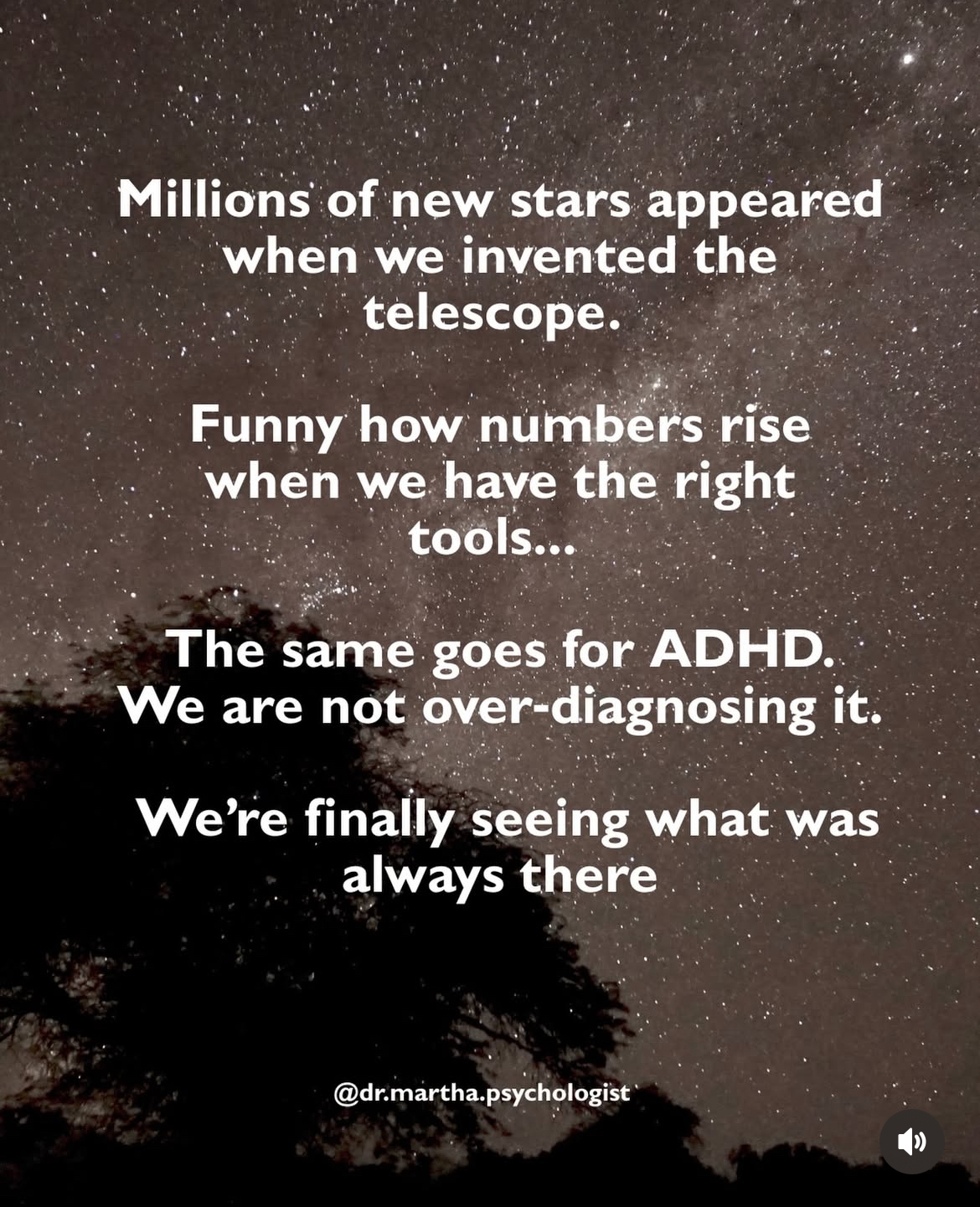
The only other topic I am going to cover today is the debunked link between paracetamol/Tylenol use and autism. The amount of parental guilt when you see your children struggling with life is HUGE. I have spent so many nights wondering what I did wrong. Was it that glass of wine I had before I knew I was pregnant? Was it my stressful job (I found out I was pregnant with our youngest just after an Ofsted inspection)? Was it the fact that all I could eat was salad and chips, and all I could drink was red-bush tea and lemonade? Was it because I worked as an assistant vet nurse, and although I was really careful not to go near anything that may cause any harm to my growing baby, I maybe should have found a different job?

No, no, no, no. Absolutely not. I did not do anything to cause my children’s neurodivergent conditions. Although as parents we have made some decisions that, looking back, could have been better, we did a pretty decent job – and still are. I took paracetamol during pregnancy when I wasn’t well because it was the safest painkiller. I have friends who were on different medications that they needed to take for their own health, and they did nothing wrong either. There have been numerous peer-reviewed studies and meta-analyses that have shown NO link between paracetamol and autism. Paracetamol does not cause autism. We are not in the middle of an epidemic; we are just finally seeing the stars.

It’s all in the genes

I was reflecting on parenthood earlier this week while walking the dogs (which I find far more meditative and mindful than meditation), and I was thinking how odd it can be when you are looking at your children’s behaviour and not seeing anything abnormal or odd as they behave exactly like you used to.

In my book (if you’d like a copy, it’s available here) I talk about what is normal, and how everyone has a different idea of what normal should be. That saying, when health visitors or other professionals ask you questions about your child’s development and you think that not sleeping through the night, or having attachment needs is normal because that’s how you and your siblings were signs or traits can be missed. We definitely missed signs of ADHD because our children behaved like we did.

There have been numerous studies that show autism and ADHD have a genetic origin (despite what is being claimed by some in the US). We are not in the middle of an epidemic, they are not caused by vaccinations, nor ‘bad’ parenting, or gluten or anything else that you may read in the papers. There is trauma-based behaviour that can mimic ADHD and ASD, but neurodivergent conditions are caused by genes.

So, if it’s a genetic ‘thing’, it will often run in families. There can be chance mutations that cause these, but often it’s a family thing. There is a suggestion that this is one of the reasons why there has been a huge increase in adults, especially adult women, getting diagnosed; it’s when their children go through assessments that they get the lightbulb moment and see so many similarities between themselves and their children, that they decide to get assessed. There are memes on social media saying when a child is diagnosed, maybe the parents should be offered an assessment as well. That’s probably not a bad idea.

You may be reading this thinking ‘there’s nobody in my family with ADHD/ASD/Dyslexia. What a load of rubbish’, and that may be the case. It may be a chance mutation that has led to neurodivergence in your children. But can I ask that you look a little closer. Is there a relative who was thought of as a little odd, or who was very flamboyant, speaking with their hands all the time, who was always taking things to bits and fixing them again, or who wanted time on their own when they came home from work? Or maybe one with a rigid schedule, who couldn’t eat a certain food? I think as we look back with our eyes opened to the possibility of it being a family thing, and we look again with an acknowledgement that these conditions have always been here, they just didn’t have a name that we start to see the patterns in our ancestors.

And also, be kind to yourself. It’s so easy to reflect with self blame – was it the occasional wine I drank, was it the soft cheese, was it this, was it that.

No, it wasn’t anything you did. It’s all in the genes.

It’s not just Ofsted

Some of you may have seen Chris Packham’s rightfully angry video about an Ofsted training manual that states that autistic children are more likely to be radicalised than their non-autistic peers. If you haven’t seen the video, have a look here.

I’ve dug a little deeper trying to find the training manual, and the closest I could find with a quick look this morning was a Huffpost quote about it (link to the article is here). A quote in the article is that the training manual reportedly says:

“Children and young people with autism are at increased risk of being susceptible to extremism. This is because they are more likely to develop special interests.

“Due to this and any social communication needs, children with autism are more likely to experience social isolation and so use the internet as a way to find friends. They trust the information they read and the ‘friends’ that they find online and so can be drawn into extremism.”

I am with Chris Packham on this. It’s an inflammatory and ableist statement that doesn’t begin to look at why this may happen, and why swathes of young people (not just autistic children) are also at risk.

Autistic children are an easy target here. The general perception of autistic people is that they’re socially awkward, gullible, they don’t have friends and they don’t have a big social group. This maybe true for some autistic people, but definitely not all of them. It’s also true for many non-autistic children. To single out one neurodivergent group is wrong.

Children are struggling in the 21st century, and even more post covid. The waiting list for support can be years long. Those with mental health issues may not be seen until they get to crisis point, and even then, at crisis point, there are often waiting lists. This is not because the NHS is bad, it’s because mental health support for all ages is woefully underfunded. CAMHS (Children and adolescent mental health services) are overwhelmed. Local governments cannot afford SEND support, and families are waiting far too long for EHCPs.

Even children without mental health issues can feel lonely and isolated, and seek a community or understanding group online.

If we look at the rhetoric in the media (print, online and social) there is so much negativity, and sectors of society are portrayed as not contributing. Added to that the pressure to look or behave a certain way, to get high grades, to achieve, to have friends, to have a social life, to get a partner, to be straight, thin, pretty, handsome…..the list goes on and on.

Imagine being 13. You’ve just moved to a new area. You are tall (or small) for your age. You’re not great at sports, you can’t afford the latest phone, and you feel that you’ll never fit in. Your parent(s) work long hours to pay the rent, so after school you’re on your own. You haven’t made new friends, you feel lonely and so you turn on your phone and start scrolling. You find a page on social media that seems to be talking to people like you. You join the group and start conversations, and you feel that people are really listening to you. You don’t feel lonely any more, and you feel that you have new friends who understand you.

You don’t have to be autistic to feel like this. It can be any teenager (or adult) who either doesn’t meet societal expectations, or just feels a little different.

Social media wasn’t a thing when I was a teen, but if it had been, there were times when I could have looked for an online tribe.

Chris Packham is right to be angry, and Ofsted should not have singled out one group of society. However, society is pushing children and young adults towards online communities. Schools are not inclusive. Many people feel disenfranchised and left out. We are a tribal species. We have evolved to be part of groups, to have a feeling of belonging. If it isn’t found in person, there’s a huge online world to find their place.

Let’s stop blaming the people who are being groomed or radicalised online and instead solve the reasons why, and give the young people the support and community they need in real life. If school and society are inclusive, and if hateful, blaming rhetoric stops, and if the media is accepting, maybe that would be the biggest step towards reducing grooming and radicalisation.

what difference does a label make?

I promise this blog won’t end up being just about me and ADHD, but this is another ADHD post!

It’s just over 3 months since I had the official ‘yes, you have ADHD’ conversation, and I can honestly say that is has had a huge, positive impact on my mental health. I obviously haven’t only had ADHD for 3 months, I have had ADHD for the past 53 years so the diagnosis and label didn’t change that at all. The diagnosis didn’t make it appear, it didn’t make it more or make it ‘worse’, but the diagnosis did change how I feel about me, and how I deal with how I feel.

For 53 years, I felt that I wasn’t enough, but I was also too much. I replayed conversations in my head over and over again. I had to stop myself butting in to conversations and finishing other people’s sentences. I felt I had nothing to say, but also had everything to say. People walking too slowly would make me stim, and if someone took to long to explain something obvious, I know my facial expression would show my boredom – this isn’t to be confused with conversations that start with one story and quickly deviate off to all kinds of unexpected places. These are my favourite conversations.

I still replay conversations, I still get fed up with people walking slowly, I will want to butt into conversations and feel all the feelings, but now I know it’s not because I’m broken, or because there’s something wrong with me. I have a brain that is whizzing at 100 miles an hour, focusing on everything and picking up on things that others may not. It’s not a superpower, but it’s me, and I am not broken.

Over the years, I have had multiple conversations with people who don’t want a label or a diagnosis, and I’ve written before that a diagnosis is a lens rather than a label; it allows other people to see and to understand, but I now understand how it also allows us to understand ourselves.

I remember when our eldest had his ADHD diagnosis, and he said it was a relief to know that he wasn’t going crazy, and that it was something that had a name. As well as allowing us to understand him a little more, it allowed him to understand himself. As he’s grown older, but before he left some, he sometimes told me that he may be having an ADHD week, so could I break things down into smaller chunks or instructions, and give specific times that things needed to be done. It could be ‘washing in the washing machine by 9am on Saturday’. This was a direct instruction with a deadline. It made things a little easier for both of us.

I understand the ‘ADHD weeks’ too – some weeks things seem to be more chaotic than others, and when they are like this, I have started using lists in my phone. I have to add a couple of things that I’ve already done so I can tick them off, as this makes the list less daunting, and also gives me a bit of a dopamine hit. I am also more honest about what’s going on with my thought process. In the past, if things didn’t go the way I expected, or if I was upset by something, I would clam up, but then be off with people close to me. Now I explain why I am feeling how I’m feeling, however obscure these feelings may seem when I say them out loud. It’s helping others to understand me, and stops me being stroppy or grumpy over something that can be resolved or understood.

Some have asked me if it was worth going to see my GP and then waiting 15 months for a diagnosis when I am in my 50s. Yes, absolutely yes. I had imposter syndrome about self diagnosis – was I just making excuses, and was I almost belittling the things that people who ‘really’ have ADHD go through? It has been liberating – and also explains why we missed so many signs and behaviours that our children had when they were younger. Your son putting a staple through his finger at 7, just to see if it would go through, doesn’t seem that odd when you did the same thing at the same age.

That saying, many are happy with self diagnosis, and that’s fine. I’m not saying everyone who thinks or knows they have ADHD or are autistic should go and get a diagnosis. It’s about doing what’s right for you.

For me finding out that I definitely have ADHD has been a game changer. I’m not on any medication, it hasn’t changed me that much, but it has allowed me to be kinder on myself, to explain how I’m feeling, and to rest when I am close to burn out.

Do I wish I had found out sooner? I’m not sure. I wish I could go back and hug my younger self and tell me everything would be ok, but I love where I am now, and finding out may have altered my course and led me somewhere else.

I feel I found out at the right time. I have ADHD, my brain is different not less, and I like it.

DIscovering me

On the 1st March 2025, I was officially diagnosed with ADHD. I was 53 and 3 weeks old.

I knew I was, deep down, but there was still doubt. I self diagnosed a few years ago when we were going through diagnoses with our children, but I didn’t tell anyone that I thought I was for ages, as I felt like a fraud. I was jumping on their bandwagon. I couldn’t have ADHD as I was a woman in my 40s. I was just a bit scatty, very messy, had lots of hobbies that I’d started and then got distracted, often felt like I didn’t belong, and the fact that I left everything until the deadline panic hit was because I was lazy.

In January 2024, inspired by a friend who had been diagnosed as an adult and had found it liberating, I spoke to my GP and then the practice mental health nurse, and using NHS ‘Right to Choose’ I was referred to Psychiatry UK and put on their waiting list (I wrote about this last year, to read the post click here). Just over 13 months after my appointment with the nurse, I had my assessment online.

I didn’t know what to expect, which sounds still as, at his request, I sat in with our youngest when he had his assessment. I was really nervous. The doctor was nice, tried to put me at ease, and then he started asking questions. Some of my answers surprised me – one was about how I did at school and in later education. I can’t fail, and I won’t fail. This isn’t because I’m a genius, it’s because I can’t. If I think I’m going to fail, I quit. And if I do a course, I have to do my absolute best and come as close to the top of the class as I can. If I can’t do well, I won’t do. The doctor seemed very interested in that!

Another question I remember clearly was what would I do if all the things on my to do list were completed. If I woke up tomorrow without any spinning plates (my words here, not his), without anything I wanted or needed to do, how would I feel.

I panicked.

I could not (and cannot) imagine having nothing to do.

I must have looked terrified as I stuttered ‘I don’t know. I have no idea. I can’t begin to imagine what that would be like’ as he told me not to worry and we’d move onto another question.

At the end of the assessment, he told me that there is no doubt whatsoever, I have ADHD. The assessment ended, I told my family, and then I went and curled up on my bed, and I cried.

I cried for the 14 year old me who watched the popular girls at school in awe, not knowing how to be like that. I cried for the younger me who always felt like an outsider. I cried for the me who couldn’t get her written work to match her classroom knowledge. I cried for me now, only just beginning to understand that I was never broken, I wasn’t an alien, and I was always enough.

Eight weeks on, and I’m still doing lots of self-reflection. I’m now seeing where I have masked and camouflaged, and I’m still not entirely sure how I can free myself of masking – and I’m pretty sure I will always camouflage and mirror, especially in social situations.

I don’t necessarily wish I’d gone for diagnosis earlier as I am happy with where I am and who I am, and even if I did regret, it wouldn’t change anything. However, I wish I could go back and hug my younger self and tell me it will all be ok. I also wish I could go back to when our children were little and realise that the behaviour I saw as normal wasn’t normal for everyone. It’s hard to see atypical behaviour when in your world it’s typical. But I didn’t know then, and I have to forgive myself.

This brings me to getting a little political. In a week when RFK Jr has talked so negatively about autism in the US, and Farage as spoken about over diagnosis in the UK, it’s important to remember that there hasn’t been a huge increase in neurodivergent conditions, we’re just beginning to see them. When I was at school in the 1980s, nobody talked about ADHD, and it definitely wasn’t something that would affect an academic, well-behaved girl, so I was missed. There is a meme on social media saying that before 1930, nobody knew about Pluto – but it was still there! It didn’t suddenly appear, it just hadn’t been seen or discovered. It’s the same with ND conditions. And as they usually have a genetic link, quite often a child is diagnosed, and then the parent(s) have a lightbulb moment, and also get assessed – and then you look at other members of the family who were seen as being a bit ‘quirky’, and suddenly it all makes sense.

ADHD, Autism and other ND conditions are not diseases, they are not caused by vaccines, they are not caused by chemtrails or anything else like that. They are a different way of thinking, being and processing. We are different, not less. We have been here since our ancestors came out of Africa, and probably before that. We’re just not hiding any more.