School report

So, GCSE and A-level results have been & gone. The media (online and print) have made their comments, and not all of those comments have been positive, some of which I wrote about last week (link here).

Successive governments have promised to ‘fix the system’, which is an admirable aim, but successive governments have not done this, and I doubt the white paper on more educational reforms due next month with be full of ideas that will make much of a difference. I will write about this when it comes out, and if I am wrong, I will hold my hands up and admit it.

I strongly believe that the main reason why education isn’t getting better, and for many, including the square pegs, it is getting worse, is for two main reasons. The first is that education is now monetised. The amount of government funds it costs to educate a young person from 5 – 16/18 needs to be repaid in the amount of tax that young person will contribute to society from when they finish their education to when they retire. The second is that the educational reforms are not driven by teachers, students or people in the classroom. They are decided and driven by politicians and civil servants.

I’ll talk about monetisation first. I fully accept that there isn’t a magic money tree, and that governments can’t keep borrowing more and more money. However, I don’t think that each piece of the government purse needs to be looked at individually. Education and the NHS are intrinsically linked. There is a mental health crisis in the UK, especially among under 25s. The waiting lists for CAMHS (Children and Adolescent Mental Health Services) are colossal. In 2022/23, almost one million children were referred to CAMHS, which is 8% of the child population. Of these, over 270,000 were still on the waiting list, and over 370,000 had their referral closed before they could get support – this may be because their parents paid for private support, because they reached 18 and were no longer eligible for CAMHS and would now have to access adult services, because they moved or missed an appointment, or for other reasons. Over 40,000 young people had been waiting for more than 2 years (the source of all of this is available here).

If we improved education so that it didn’t have such a negative impact on many young people’s mental health and well being, if we had more staff trained to spot the early signs of depression, anxiety, OCD, eating disorders etc, and if schools were more ND/Square peg friendly, this would reduce the amount of young people struggling and seeking help from CAMHS. The amount of children home schooled (EHE – elected home educated) or EOTAS (educated other than at school) is also increasing, another sign that the current education system does not meet the needs of all our young people.

We don’t need education reform, we need a complete overhaul of the system. Despite increased testing throughout school (I’ll come onto this in a moment), over 40% of those taking English and maths exams this summer did not get a grade 4 or above (grade 4 is the equivalent of a C grade with the old marking scheme & O-levels). Either the testing is wrong, or the education system is not geared up for 40% of young people taking exams. Now, not everyone is capable of passing 3 maths papers and 2 English papers. Not everyone will get to the grade 4 standard, however we assess them. But something needs to change so that more people are not held back by being part of that 40%. Maths and English passes are needed for so many future opportunities, from achieving a level 3 or higher apprenticeship, to some vocational qualifications (vet nursing and farriery are two), for teacher training, for university and more. I have taught some amazing people who worked in residential children’s homes or care homes. They were fantastic at their jobs, and they were respected within their teams, but because GCSE or Functional Skills exams were difficult for them, they could not achieve their level 3 qualification.

Repeated testing from KS1 (age 5-7) all the way through school to GCSEs and level 3 qualifications will not improve how young people learn. As a biologist, I know that there is no such thing as an average human, and even more so when we look at young people. We do have average milestones, and if a baby or toddler is very late reaching one or more, that can be a cause for concern, but all people learn and develop at different rates. Both of my children, for example, were out of nappies months before their second birthday, but didn’t sleep through the night til they were 3 or more. A friend’s son slept through from about 6 months, but was in nappies til he was almost 3. My children are no better or worse than hers, they just developed differently. Testing little children for how they hold a pencil, how long they can sit still, if they can spell their name, if they can read 10 high frequency words and then keeping these results is, in my opinion, worth very little. Teachers, TAs and nursery nurses do need to keep track and make sure that children are learning, but this can, and should, be learning through play, conversations, games and stories rather than teaching them to hit milestones.

As we move up into KS2, the end goal is SATs that are taken at the end of year 6, just before secondary school. These assess English, maths and science, not how well an 11 year old can hold a conversation, or how well they understand the world around them, or how amazing they are with their hobby. More assessments through KS3, and then formal assessments at 16. More and more testing and teaching to benchmarks obviously isn’t working for over 40% of young people as they are not hitting the benchmarks at 16.

What’s the answer then? Well, I think the first step in education is to start with developing a love of learning, and learning for pleasure and to find out interesting things, rather than being taught how to regurgitate information in a test. We then need to make lessons fun – for the teachers as well as the students – so that inquiry and desire for more information grows. At that point, there is a purpose to writing and reading, and numbers start to matter (how tall was a T-rex, how many goals did Harry Kane score last season, for example). Once there is a purpose to the fundamentals, there will be a motivation to develop them and master them.

If I was to grade the education system in the UK, I would give it a 3 (or a low D). There are some good parts, there are some outstanding classroom staff, but, as a whole, it isn’t hitting benchmarks and must do better.

Don’t believe the hype….

This is the weekend between Level 3 (A-levels, T-levels, BTECs) and Level 2 (GCSE, BTECs) results, and for families who are waiting for both sets, you have my deepest sympathies!

Since Thursday morning, the media (social, online and print) has had stories about how this year’s results compare to previous years, and how many students are about to head off to university. The main headlines have been how the results are up this year, and the number of entries achieving A* or A is up for the second year, as are the top grades for T-level (Technical levels are a relatively new qualification) and other vocational level 3 quals (such as BTECs).

This all makes further education/sixth form education sound great, they’ve all done amazingly well, so congrats to them, and the Department for Education is amazing too as the top grades are up again.

It’s not that simple, and these stories about higher grades and getting university places can make the world seem a little darker if you or a teen you look after didn’t get higher grades, and hasn’t been able to find a place at university. I feel your pain right now. We went through this 10 years ago, and it was tough. The headlines don’t matter if your house can’t share the joy, and although alternatives may be found that actually carve out a better path, it might not feel like that right now. Things will all work out, the sun will shine again, but for now, take time to breathe, and sit with them in the shade until they’re ready to see the sunlight again.

To repeat myself, it’s not as simple as higher grades this year that are building on the higher grades from last year. It’s more complicated than that. In 2020 and 2021, A-level and GCSE grades were not generated by the exam boards:

2020 – teacher grades that then got fed into an algorithm that looked at the school, the area and previous results and came up with grades that were heavily criticised by schools and students.

2021 – centre assessed grades that were more rigorous and subject to scrutiny, and although still not perfect, were better than 2020.

In 2022, students went back to formal exams and assessments, but the marking took into account the previous 2 Covid years, and so results were higher as the marking was kinder.

In 2023, in England (this was not the case in the other nations) assessments went back to pre-Covid marking, and in 2023, A-level grades dropped from the previous 2 Covid years. Purely anecdotal, but my son’s cohort all got at least one grade lower than predicted in each subject.

So, in 2024 in England, the results were higher, and were back to pre-Covid levels in England, which isn’t really a surprise as the GCSE and A-level results were not taken in lockdown years, and this year the results are slightly higher again – but not as high as the press would maybe have you believe from their headlines. In 2023 26.5% of entries achieved A or A*, and in 2025 it was 28.2%. So a rise of less than 2% over 2 years. In Wales the top grades have dropped by 0.4%, and in Northern Ireland, they have increased by 0.1%. Not exactly anything for the press to shout about – but well done to all of those who got these grades, you have plenty to shout about.

Information about the inequality gap has also been a little vague in the press. This year more boys than girls achieved the higher grades (9.8% compared to 9.1%), but boys were also more likely to achieve lower grades (21.2% compared to 18.5% of girls), and I only heard one news article mentioning this.

More worrying for me, are the regional and school gaps. More young people in London, the East and the South Easter got the higher grades compared to the rest of the country, with the North East getting the smallest percentage of higher grades. The school you go to can also impact the grades you have, with students from independent or selective schools more likely to get the higher grades. That doesn’t mean that young people in comprehensives in Sunderland won’t get fantastic grades, it just means that you are more likely to get higher grades if you attend an independent school in London or the South East.

The media pick and choose which bits of information they post, and the same will happen on next Thursday as GCSE results are published. I predict similar regional variations, and similar sensationalising headlines.

At the end of the day, the young people getting their results this August are still part of the Covid generation. Their first years at secondary school were interrupted by lockdown and online learning. They missed out on face to face interactions, and so whatever their results may be, they are all amazing!

All grade information here was taken from https://ffteducationdatalab.org.uk/2025/08/a-level-t-level-and-other-level-3-results-2025-the-main-trends-in-grades-and-entries/

Results day(s)

In England, Wales and Northern Ireland, many 15-18 year olds will be on edge. The last 11+ years have all led to the moment when they open the email or go to school or log onto a portal. In that moment when they look at their results, they will know if they have been a success or a failure in education……..

Except, in the real work, that’s not how it works and that’s not how it ends. Headlines in the press and on social media about A-level and then GCSE results being up or down, about a north/south/east/west divide and how girls or boys have been better or worse this year are there to make us believe that this is it. Whatever those results, they will follow us and haunt us for the rest of our lives – but they won’t.

Education is becoming more and more monetised. A Government document released earlier in July this year is titled ‘Key Stage 2 attainment and lifetime earnings’ (link here) and in it, the levels in KS2 SATs are linked to what that 11 year old may earn in their lifetime. What a load of rubbish, and how awful to have a report that looks at SATs results and how much tax these CHILDREN may pay in their lifetimes. Nothing about happiness, health, mental well being or anything important, just their potential lifetime earnings. There will be similar research out there for GCSE/level 2 results and A-level/level 3 results, and these obviously will include Scottish Nationals and Highers.

Young people’s exam results matter – I am not saying they don’t. What happens over the next year or two will be directly influenced by their results. University, apprenticeships, work, college places may all depend on the numbers of A, B Cs and 9-4s, but life does go on if the required grades don’t appear on the results slip.

What we need to do as we approach results days (and apologies to any readers in Scotland, this is a week too late, I will do better next year) is be there for our young people. I’ll write a more detailed post about what to do if the grades for uni haven’t been met and publish this on Wednesday, but as a general rule, be there for them. Let them feel whatever feelings they are experiencing. Do not berate them or tell them off – what’s done is done. You can’t rewind time, you can’t change the outcome, you can’t shout at the teachers. What you can do, is offer them unconditional love and support, and then, when they’re ready, help them to decide what comes next, be that resits, a different uni course, alternative employment or a year out.

Sometimes getting unexpected results is a good thing. Results that are better than expected can open more doors, and results that are less than expected can open new doors, and both of these can lead to more opportunities. I have personal experience of this (my A-level grades were not what was expected) and also as a parent, and I know it can be tough.

Whatever the results, and whatever way your young people have experienced education (Academy, LEA state school, private school, special school, AP, college, home school, unschool, online school or something else), they’ve done it. At 16 they are through primary and secondary, and they have the freedom to choose school, college, employment or apprenticeships, and at 18 they are done with formal education. Whatever their results day brings, they’ve done it their way, and you should be incredibly proud.

Burn Out

21st century life in the Western World seems to be focused on productivity and results. Via our phones we have access to the internet, social media and emails (work and personal) 24 hours a day. Even though it’s not expected of me at all, I know I check work emails in the evening and at weekends. I also struggle to do nothing, and feel that I have wasted a day if I haven’t ‘done’ anything. I’ve put done in quotation marks as a day resting is still doing something, but my 21st century ADHD brain does not see that as doing something meaningful.

It’s been a busy term at work, and it’s been a busy term at home. The summer term always feels very long, and alongside this there are exam & coursework deadlines, tired learners, tired staff, and we have had the knowledge that Ofsted could visit at any time. I was torn between wanting it this term to get it out of the way, even though we were all tired, as it would be before the new inspection standards arrive in September, and hoping it would be at the end of September when everything was new and fresh.

At home, I have been busy studying. My self-imposed deadline to get all of my doctoral research done and in was the end of the term – and I did it. Huge thanks to any colleagues who are reading this who took part in a focus group discussion during a particularly tiring week, and the lovely young people who agreed to tell me their stories. I am so pleased it’s all in – just analysing and writing for the next 18 months now – and that I hit my deadline.

However, all of this meant that when we finally broke up on Tuesday, I was done. I was burnt out. I was so tired and emotional, and I felt ill. I even did a Covid test as I felt as washed out as I had when I had it. Wednesday I listened to my body – still did an Ikea and Costco trip with my grown up children, and had a uni meeting in the evening, but in between I rested. I resisted the urge to pick up a book and read, and to do some crafting. Instead I flopped on the sofa and watched old episodes of ER. Thursday things got a bit messy again, but I ignored my body and didn’t rest, so Friday was a day of relaxed coffees and reading, and then family time in the evening.

It has taken me over 50 years to learn when I was in burn out. Before I used to get cross with myself for not being able to be my best all the time, for getting over emotional or for wasting a day resting. I hope I have taught my children to do it better, to listen to their bodies, to rest when they need to. We don’t have to do everything every day. A day of rest is a day of doing. Turning off our emails and social media is fine – we can catch up later on or tomorrow. We won’t be able to be our best if we are running on empty, or we are out of spoons.

I have learnt self acceptance this week. I am not invincible, I will, and do, burn out when it gets too much. I am learning to rest when I need to. I hope you will too.

School’s Out!

Most (but not all) schools have now broken up for the summer holidays. Some Nottinghamshire schools still have 2 days to go (and it may be the same in some other counties as well), but the holidays are just about here. Young people have between 5 and 8 weeks off to relax, refresh, unwind and let their brains absorb everything that’s been going on for the last 11 months.

Inevitable social media posts and memes have started doing the rounds. Teachers have too many holidays, parents can’t afford to have time off so why should teachers (spoiler, many teachers are parents as well), 5/6/7/8 weeks is far too long for children to be away from school, and holiday companies charge too much for holidays when the schools are off. Let me look at those one by one.

Teachers will be working over the holidays. I will be planning for next year, I will be reading the books we will be covering in literacy lessons, I’ll be researching new topics (new cohort, new interests), and I will be getting up to date with the changes to Ofsted inspections that are starting in September, and any changes in safeguarding legislation. I’ll also be doing work for my doctorate degree, seeing friends and fitting in a trip to Cornwall, as well as spending time with my own children. I don’t break up til Tuesday, so all this will be done in my 4.5 weeks off – and I’m not complaining. I’m lucky to have a job where I can spend the summer at home, choosing when to do school work, uni work and have family time. I also need a break. I love my job, but when it gets to the end of the school year, I am ready for a bit of time away from the learners. I spend 5+ hours a day with the young people I teach, and the break gives me time to pause and breathe, and go back in September refreshed and ready for the next academic year.

The school holidays in the UK are less than many other countries. In England, children have approximately 13-14 weeks of holidays each year. Ireland, Scotland and Scandinavian countries have 15 weeks, France and Spain both have 16 weeks, Italy has 16-17 weeks, and US states have between 14 and 20 weeks off. We have less than many other countries!

I agree that holidays clubs and childcare can be horrendously expensive. But rather than saying children need to be at school more, shouldn’t we be able to add some work-life balance with more paid holidays, or options to buy holidays off our employers? Surely we didn’t have children to only see them for 4 weeks a year? I have friends (male and female, no ‘mothers stay at home’ bias here (unless they want to)) who would love to spend more time at home in the school holidays, but they can’t because if you only get 4 weeks holiday a year, you quickly run out of annual leave.

Our children (and us) need down time. As the National Curriculum gets more and more demanding, and as more assessments are introduced, our children – and they are children, not mini adults – need time to play, to be outside, to watch films, to visit places, and to be bored. They need time out of a classroom to learn all the skills that school just cannot teach them, and they need to learn by play, not by rote. And this applies to all children, even the grumpy teenage ones.

Basic economics of demand and supply mean that more people looking to get away in the school holidays = more expensive holidays. Shortening the school holidays would worsen this, and if everyone took holidays in term time, then children would miss lessons. If the parents are happy to help them catch up, I don’t have a problem with this, but how many parents have time in the evenings after work and after homework is done to then spend an hour looking at mean, median and mode or fronted adverbials? The problem here lies with the holiday companies, not the education system.

Teaching is a tough job, which is why teacher recruitment and retention is low. We need a bit of time away from your darlings to spend time with our own families, and to rest. Your children are also children, they need time out of the classroom as well. And they also need down time, not going from activity to activity. A few years ago, I was unwell throughout the summer. We didn’t do much, and I felt I had given my children a rubbish summer. They, however, disagreed. They had loved that summer. They left Lego all over the lounge floor for days, building and rebuilding and letting their imaginations soar. They built dens in the garden, we had movie days where we got our duvets and watched film after film, and we chatted and baked. On the days when I felt OK we went out and did things, but they saw it as the most relaxed and fun summer that we’d had for ages! So if you do have time off with your children, it doesn’t have to cost you a fortune.

There’s another meme that says we only have 18 summers with our children. Well, I can categorically tell you this is not true. Our children are now in their 20s, and we still spend time with them and make memories, and I’m in my 50s and I still make memories with my parents. However, I do think that we need to have time with them, if annual leave allows, and enjoy their company.

However you spend it, I hope you get time to enjoy a summer that’s full of conversations and smiles.

It’s all in the genes

I was reflecting on parenthood earlier this week while walking the dogs (which I find far more meditative and mindful than meditation), and I was thinking how odd it can be when you are looking at your children’s behaviour and not seeing anything abnormal or odd as they behave exactly like you used to.

In my book (if you’d like a copy, it’s available here) I talk about what is normal, and how everyone has a different idea of what normal should be. That saying, when health visitors or other professionals ask you questions about your child’s development and you think that not sleeping through the night, or having attachment needs is normal because that’s how you and your siblings were signs or traits can be missed. We definitely missed signs of ADHD because our children behaved like we did.

There have been numerous studies that show autism and ADHD have a genetic origin (despite what is being claimed by some in the US). We are not in the middle of an epidemic, they are not caused by vaccinations, nor ‘bad’ parenting, or gluten or anything else that you may read in the papers. There is trauma-based behaviour that can mimic ADHD and ASD, but neurodivergent conditions are caused by genes.

So, if it’s a genetic ‘thing’, it will often run in families. There can be chance mutations that cause these, but often it’s a family thing. There is a suggestion that this is one of the reasons why there has been a huge increase in adults, especially adult women, getting diagnosed; it’s when their children go through assessments that they get the lightbulb moment and see so many similarities between themselves and their children, that they decide to get assessed. There are memes on social media saying when a child is diagnosed, maybe the parents should be offered an assessment as well. That’s probably not a bad idea.

You may be reading this thinking ‘there’s nobody in my family with ADHD/ASD/Dyslexia. What a load of rubbish’, and that may be the case. It may be a chance mutation that has led to neurodivergence in your children. But can I ask that you look a little closer. Is there a relative who was thought of as a little odd, or who was very flamboyant, speaking with their hands all the time, who was always taking things to bits and fixing them again, or who wanted time on their own when they came home from work? Or maybe one with a rigid schedule, who couldn’t eat a certain food? I think as we look back with our eyes opened to the possibility of it being a family thing, and we look again with an acknowledgement that these conditions have always been here, they just didn’t have a name that we start to see the patterns in our ancestors.

And also, be kind to yourself. It’s so easy to reflect with self blame – was it the occasional wine I drank, was it the soft cheese, was it this, was it that.

No, it wasn’t anything you did. It’s all in the genes.

It’s not just Ofsted

Some of you may have seen Chris Packham’s rightfully angry video about an Ofsted training manual that states that autistic children are more likely to be radicalised than their non-autistic peers. If you haven’t seen the video, have a look here.

I’ve dug a little deeper trying to find the training manual, and the closest I could find with a quick look this morning was a Huffpost quote about it (link to the article is here). A quote in the article is that the training manual reportedly says:

“Children and young people with autism are at increased risk of being susceptible to extremism. This is because they are more likely to develop special interests.

“Due to this and any social communication needs, children with autism are more likely to experience social isolation and so use the internet as a way to find friends. They trust the information they read and the ‘friends’ that they find online and so can be drawn into extremism.”

I am with Chris Packham on this. It’s an inflammatory and ableist statement that doesn’t begin to look at why this may happen, and why swathes of young people (not just autistic children) are also at risk.

Autistic children are an easy target here. The general perception of autistic people is that they’re socially awkward, gullible, they don’t have friends and they don’t have a big social group. This maybe true for some autistic people, but definitely not all of them. It’s also true for many non-autistic children. To single out one neurodivergent group is wrong.

Children are struggling in the 21st century, and even more post covid. The waiting list for support can be years long. Those with mental health issues may not be seen until they get to crisis point, and even then, at crisis point, there are often waiting lists. This is not because the NHS is bad, it’s because mental health support for all ages is woefully underfunded. CAMHS (Children and adolescent mental health services) are overwhelmed. Local governments cannot afford SEND support, and families are waiting far too long for EHCPs.

Even children without mental health issues can feel lonely and isolated, and seek a community or understanding group online.

If we look at the rhetoric in the media (print, online and social) there is so much negativity, and sectors of society are portrayed as not contributing. Added to that the pressure to look or behave a certain way, to get high grades, to achieve, to have friends, to have a social life, to get a partner, to be straight, thin, pretty, handsome…..the list goes on and on.

Imagine being 13. You’ve just moved to a new area. You are tall (or small) for your age. You’re not great at sports, you can’t afford the latest phone, and you feel that you’ll never fit in. Your parent(s) work long hours to pay the rent, so after school you’re on your own. You haven’t made new friends, you feel lonely and so you turn on your phone and start scrolling. You find a page on social media that seems to be talking to people like you. You join the group and start conversations, and you feel that people are really listening to you. You don’t feel lonely any more, and you feel that you have new friends who understand you.

You don’t have to be autistic to feel like this. It can be any teenager (or adult) who either doesn’t meet societal expectations, or just feels a little different.

Social media wasn’t a thing when I was a teen, but if it had been, there were times when I could have looked for an online tribe.

Chris Packham is right to be angry, and Ofsted should not have singled out one group of society. However, society is pushing children and young adults towards online communities. Schools are not inclusive. Many people feel disenfranchised and left out. We are a tribal species. We have evolved to be part of groups, to have a feeling of belonging. If it isn’t found in person, there’s a huge online world to find their place.

Let’s stop blaming the people who are being groomed or radicalised online and instead solve the reasons why, and give the young people the support and community they need in real life. If school and society are inclusive, and if hateful, blaming rhetoric stops, and if the media is accepting, maybe that would be the biggest step towards reducing grooming and radicalisation.

let’s talk pants

First of all, if anyone who knows me reads this, I will be sharing some info about clothing and underwear preferences, so if this makes you uncomfortable, it’s probably best to just skip the rest of this blog and come back next week.

If you spend time on ND forums and social media pages, as I do, you will have noticed that there are lots of questions about clothing for young ASD/ADHD/ND children. Where can you get socks without seams? What soft trousers have people found? How do you persuade a young person to get dressed before leaving the house? And many, many more. These questions are usually met with a plethora of replies, many really good and useful, some not so useful and some, to be completely honest, a little too out there.

However, once our children get to teenage years, and as they, and we, grow older, we are trying to find a compromise between our sensory needs and what the fashion industry says we should be wearing – in terms of clothes, make up, aesthetics and even body size (a really good insta follow that talks a lot about body image and the media is @alexlight_ldn).

I’ve always managed to (more or less) do my own thing in terms of clothing and body. I’ve always have my own look (jeans, T-shirt, hoody, flip flops/sneakers/ballet pumps) that hasn’t really changed that much over the last 40 years. Teen me wouldn’t look that different to 50s me, and I’ve even gone back to the double denim I loved in the 90s! But I have still bowed to fashion pressure, especially when it comes to underwear.

I have wasted so much money over the last 40 years on pretty bras that are just uncomfortable and not fit for purpose. Underwired, no wired, push up, push out….the choices go on and on, but there doesn’t seem to be a category in any lingerie department for ‘might not look that pretty but keeps everything in place and is comfortable all day long’. On a normal day, who is going to see your bra? Does it matter if it’s not lacy, or if it is? Does it matter if it matches your pants? Nope, not at all.

And now I’ve mentioned pants…. like bras, I have tried a variety of styles, fits, colours, materials and while the fashion industry may think all women should have matching sets, I’d much rather be comfortable!

If you look at kids’ pants (boys and girls), they are fun! You can get pants with all kinds of prints and patterns – superheroes, dinosaurs, flowers, camo….the list goes on. They are also in all kinds of cool colours. There are some companies that make fun pants for adults (OddBalls for men, women & children and Locket Loves for women are two that I’ve used). Just imagine fun pants for adults, where you can pick the pants for the day you’ve got. Meeting with the boss today, so I’m wearing my dragon pants. Chilled day out with friends? Think it’s time for flamingo boxers. Interview? Must be time for those Steam Punk skull pants at the back of the drawer. I have a collection of empowering pants, and I do pick my pants for the day ahead!! See, it makes perfect sense. However, if matching sets are your thing and patterned pants fill you with horror, that’s fine, keep being you!

The importance and point of this rambling (and there is a point) is that sensory needs around clothing don’t suddenly stop when we get to 16 or 18 or 25 or 50, but as we, and the young people we are looking after, become teenagers and then adults, we we start to juggling societal expectations and what shops offer us as well as our sensory needs. There are work dress codes as well, which can be tricky. I have always worn quite tight jeans and now I understand about my ADHD needs, I understand why I favour my jeans – leggings aren’t the right material, they don’t give that sensory squish. I do wear baggy trousers in the summer when it’s just too hot for jeans, but I’d rather be wearing denim shorts. I adapt my clothes for work, and for different situations, but jeans, baggy T and bare feet is my favoured outfit and how you find me at home, weather permitting. I’ve tried to be a dress person, and I have a few lovely dresses that I wear on nights out, but as soon as I’m home, the dress is off, and the jeans are back on.

I don’t wear much makeup. Mascara is an every day essential, but that’s it. Pre children, in the mid-1990s I went for an interview at Mothercare, and was told I would need to wear make up for the role as the lights were very bright and would make me look washed out. I got called for a second interview, so I put ‘night out’ make up on, and was told in the second interview that I would have to wear more make up. If this happened in 2025, I would challenge them, ask them if men wore makeup too, and would shout and scream. Late teens/early 20s me just withdrew my application and walked away from the job. Why did how much make up I wore impact how I sold prams to expectant mums and dads? I’ve also worked with people who were told they wore a bit too much makeup for shop work or teaching. Again, how does the amount of eye liner someone wears, if a man wears makeup, or if anyone wears false eyelashes, has piercings or tattoos impact their ability to do their job?

If you’ve stayed with me to the end of this week’s rambling, well done, and my take home message is wear the pants (& bra) that makes you feel comfortable and ready to face the day. Put as much or as little make up on as you want, wear the skinny jeans, or dress, or combats and show the world how amazing you are as you! I’m now off to find those dinosaur pants…….

Different not less

We have a 5 month old puppy who came to us via an amazing local rescue. He is a labradoodle, although he looks and acts far more Labrador than poodle. He gets on well with our older lab, Ned, he is best buddies with our rescue cat, Salem, and even gets on with the rescue ponies (there seems to be a rescue theme here!).

Image description: Labradoodle puppy lying on a grey and white fleece on a red sofa with a black cat lying next to him

He runs, jumps, plays, sleeps (occasionally), torments the cat and sits and cries where we hang up his lead when it’s time for a walk. He’s just started puppy classes, and, hopefully, in about 6 weeks, he should a have his Kennel Club Good Citizen Scheme puppy certificate. Once he has this, we will then work towards bronze and maybe silver and gold, but one step at a time.

He loves walks and going on adventures. He wants to say hello to every person and every dog that we pass. He LOVES water, so we try and choose walks that include a stream to paddle in. He has a penchant for plants, and is often seen with muddy paws and an empty plant pot in his mouth. He loves carrying clothes, and if we ignore him, he runs upstairs to see if there is anything that hasn’t been put away that he can bring down to us. This has included socks, T-shirts, my work fleece and a pair of jeans!

So what has this got to do with different not less?

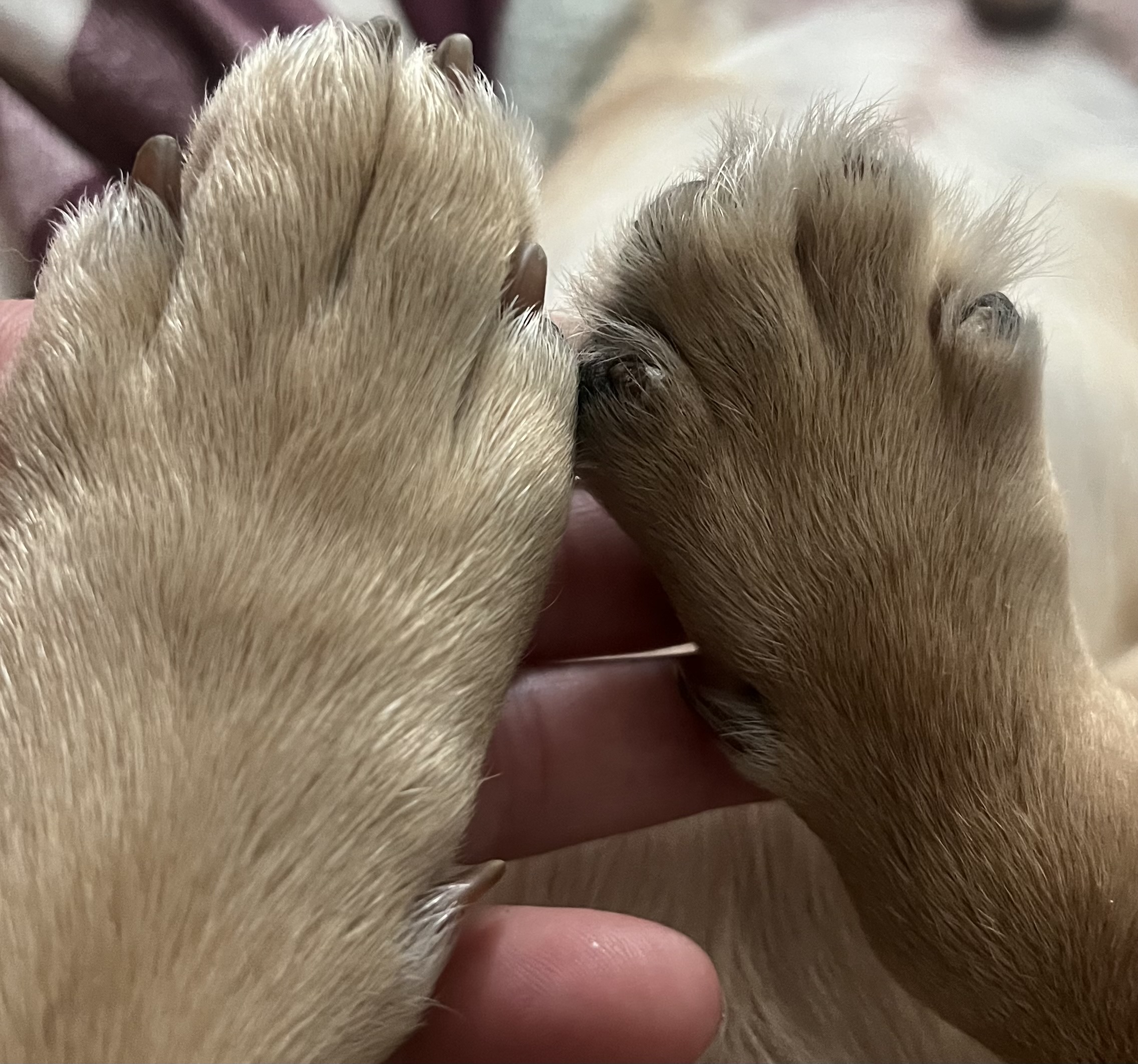
He has a different anatomy to most dogs. His right front leg is twisted, and is smaller than his left leg. He had x-rays when he was with the rescue, and it’s something he was born with. His shoulder blade is normal, and then from his elbow it all goes a bit wonky. When he walks, he walks with a limp as his front limbs are different sizes but when he runs, he hops and looks just like any other dog. His right paw is noticeably smaller than his left.

Image description: two front paws of a labradoodle puppy. The left is the expected size for a 5 month old puppy but the right paw is significantly smaller

We know that at some point in the future, he may have to have the leg amputated – but he might not. We have spoken at length to the rescue and to our vets, and we are treating him like any other 5 month old puppy. We don’t walk him too far, but at home he has as much free exercise as he wants. He is walked off the lead in the field every morning and afternoon so he can choose if he wants to walk, run, chase Ned or just potter by my side (FYI it’s usually chase Ned).

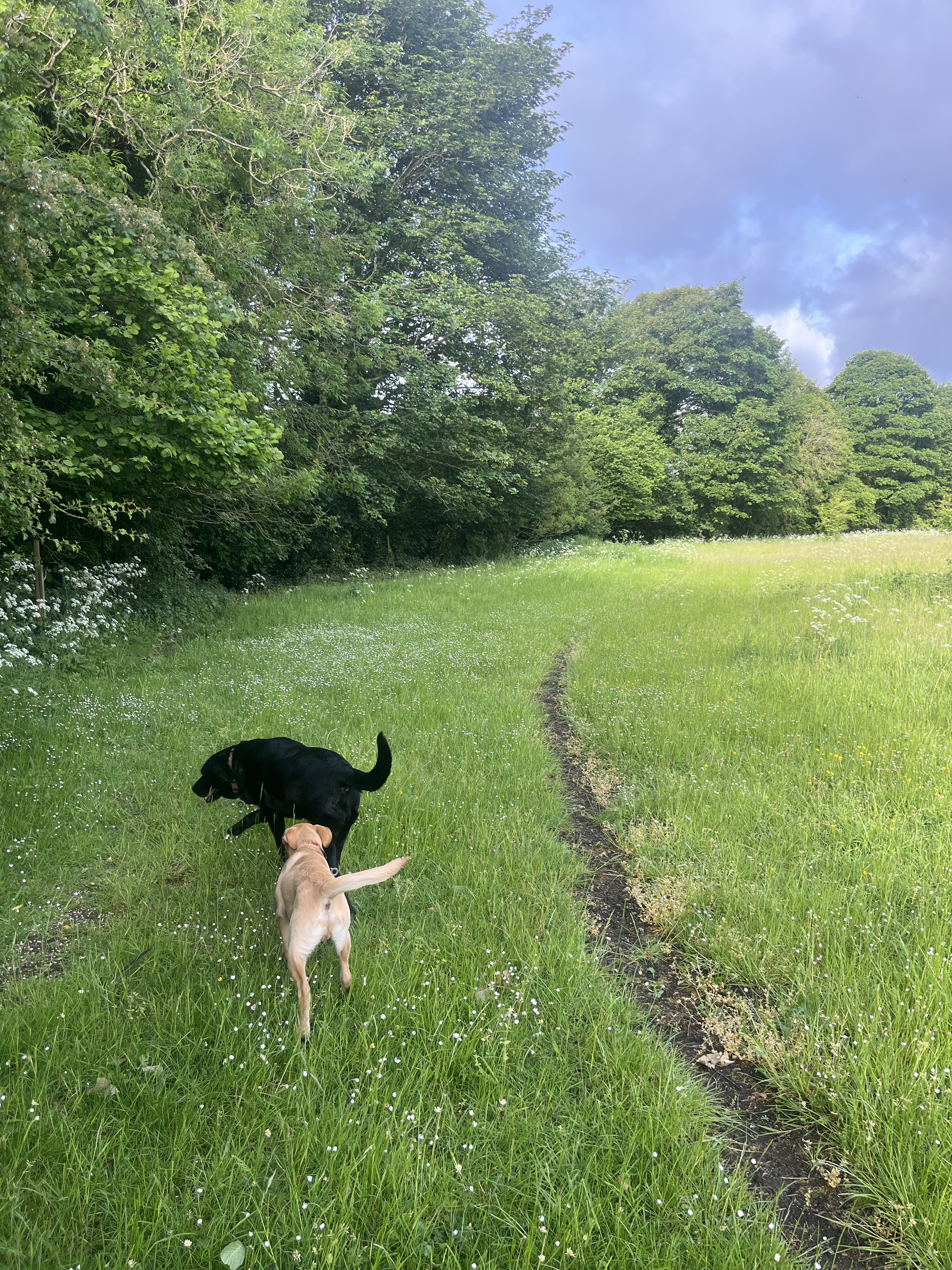
Image description: a yellow labradoodle puppy chasing a black Labrador in a field. There are trees along the left side of the picture, they are running on grass and daisies. The sky has grey clouds.

At the moment, there isn’t anything that is dis-abled about him. He jumps over chairs, he climbs onto and off the table if there’s a chair close by. He digs holes, he chases the cat, he runs up and down stairs, he runs off with stolen treasures. His anatomy may be a little different, but he is not less, and he is no less able than any other puppy of the same age. We have never said ‘I don’t think he could manage that’ but we have listened to him. When he first arrived, climbing the hill in our garden was hard work, so we let him take the time he needed. His muscles got stronger, and within a week he was running up and down it.

He is different, not less. This is something we need to remember we when look at our square pegs, and maybe we need to remind others that they may be a little different to what we were expecting, but they are definitely not less, and not dis-abled.