It’s all in the genes

I was reflecting on parenthood earlier this week while walking the dogs (which I find far more meditative and mindful than meditation), and I was thinking how odd it can be when you are looking at your children’s behaviour and not seeing anything abnormal or odd as they behave exactly like you used to.

In my book (if you’d like a copy, it’s available here) I talk about what is normal, and how everyone has a different idea of what normal should be. That saying, when health visitors or other professionals ask you questions about your child’s development and you think that not sleeping through the night, or having attachment needs is normal because that’s how you and your siblings were signs or traits can be missed. We definitely missed signs of ADHD because our children behaved like we did.

There have been numerous studies that show autism and ADHD have a genetic origin (despite what is being claimed by some in the US). We are not in the middle of an epidemic, they are not caused by vaccinations, nor ‘bad’ parenting, or gluten or anything else that you may read in the papers. There is trauma-based behaviour that can mimic ADHD and ASD, but neurodivergent conditions are caused by genes.

So, if it’s a genetic ‘thing’, it will often run in families. There can be chance mutations that cause these, but often it’s a family thing. There is a suggestion that this is one of the reasons why there has been a huge increase in adults, especially adult women, getting diagnosed; it’s when their children go through assessments that they get the lightbulb moment and see so many similarities between themselves and their children, that they decide to get assessed. There are memes on social media saying when a child is diagnosed, maybe the parents should be offered an assessment as well. That’s probably not a bad idea.

You may be reading this thinking ‘there’s nobody in my family with ADHD/ASD/Dyslexia. What a load of rubbish’, and that may be the case. It may be a chance mutation that has led to neurodivergence in your children. But can I ask that you look a little closer. Is there a relative who was thought of as a little odd, or who was very flamboyant, speaking with their hands all the time, who was always taking things to bits and fixing them again, or who wanted time on their own when they came home from work? Or maybe one with a rigid schedule, who couldn’t eat a certain food? I think as we look back with our eyes opened to the possibility of it being a family thing, and we look again with an acknowledgement that these conditions have always been here, they just didn’t have a name that we start to see the patterns in our ancestors.

And also, be kind to yourself. It’s so easy to reflect with self blame – was it the occasional wine I drank, was it the soft cheese, was it this, was it that.

No, it wasn’t anything you did. It’s all in the genes.

It’s not just Ofsted

Some of you may have seen Chris Packham’s rightfully angry video about an Ofsted training manual that states that autistic children are more likely to be radicalised than their non-autistic peers. If you haven’t seen the video, have a look here.

I’ve dug a little deeper trying to find the training manual, and the closest I could find with a quick look this morning was a Huffpost quote about it (link to the article is here). A quote in the article is that the training manual reportedly says:

“Children and young people with autism are at increased risk of being susceptible to extremism. This is because they are more likely to develop special interests.

“Due to this and any social communication needs, children with autism are more likely to experience social isolation and so use the internet as a way to find friends. They trust the information they read and the ‘friends’ that they find online and so can be drawn into extremism.”

I am with Chris Packham on this. It’s an inflammatory and ableist statement that doesn’t begin to look at why this may happen, and why swathes of young people (not just autistic children) are also at risk.

Autistic children are an easy target here. The general perception of autistic people is that they’re socially awkward, gullible, they don’t have friends and they don’t have a big social group. This maybe true for some autistic people, but definitely not all of them. It’s also true for many non-autistic children. To single out one neurodivergent group is wrong.

Children are struggling in the 21st century, and even more post covid. The waiting list for support can be years long. Those with mental health issues may not be seen until they get to crisis point, and even then, at crisis point, there are often waiting lists. This is not because the NHS is bad, it’s because mental health support for all ages is woefully underfunded. CAMHS (Children and adolescent mental health services) are overwhelmed. Local governments cannot afford SEND support, and families are waiting far too long for EHCPs.

Even children without mental health issues can feel lonely and isolated, and seek a community or understanding group online.

If we look at the rhetoric in the media (print, online and social) there is so much negativity, and sectors of society are portrayed as not contributing. Added to that the pressure to look or behave a certain way, to get high grades, to achieve, to have friends, to have a social life, to get a partner, to be straight, thin, pretty, handsome…..the list goes on and on.

Imagine being 13. You’ve just moved to a new area. You are tall (or small) for your age. You’re not great at sports, you can’t afford the latest phone, and you feel that you’ll never fit in. Your parent(s) work long hours to pay the rent, so after school you’re on your own. You haven’t made new friends, you feel lonely and so you turn on your phone and start scrolling. You find a page on social media that seems to be talking to people like you. You join the group and start conversations, and you feel that people are really listening to you. You don’t feel lonely any more, and you feel that you have new friends who understand you.

You don’t have to be autistic to feel like this. It can be any teenager (or adult) who either doesn’t meet societal expectations, or just feels a little different.

Social media wasn’t a thing when I was a teen, but if it had been, there were times when I could have looked for an online tribe.

Chris Packham is right to be angry, and Ofsted should not have singled out one group of society. However, society is pushing children and young adults towards online communities. Schools are not inclusive. Many people feel disenfranchised and left out. We are a tribal species. We have evolved to be part of groups, to have a feeling of belonging. If it isn’t found in person, there’s a huge online world to find their place.

Let’s stop blaming the people who are being groomed or radicalised online and instead solve the reasons why, and give the young people the support and community they need in real life. If school and society are inclusive, and if hateful, blaming rhetoric stops, and if the media is accepting, maybe that would be the biggest step towards reducing grooming and radicalisation.

let’s talk pants

First of all, if anyone who knows me reads this, I will be sharing some info about clothing and underwear preferences, so if this makes you uncomfortable, it’s probably best to just skip the rest of this blog and come back next week.

If you spend time on ND forums and social media pages, as I do, you will have noticed that there are lots of questions about clothing for young ASD/ADHD/ND children. Where can you get socks without seams? What soft trousers have people found? How do you persuade a young person to get dressed before leaving the house? And many, many more. These questions are usually met with a plethora of replies, many really good and useful, some not so useful and some, to be completely honest, a little too out there.

However, once our children get to teenage years, and as they, and we, grow older, we are trying to find a compromise between our sensory needs and what the fashion industry says we should be wearing – in terms of clothes, make up, aesthetics and even body size (a really good insta follow that talks a lot about body image and the media is @alexlight_ldn).

I’ve always managed to (more or less) do my own thing in terms of clothing and body. I’ve always have my own look (jeans, T-shirt, hoody, flip flops/sneakers/ballet pumps) that hasn’t really changed that much over the last 40 years. Teen me wouldn’t look that different to 50s me, and I’ve even gone back to the double denim I loved in the 90s! But I have still bowed to fashion pressure, especially when it comes to underwear.

I have wasted so much money over the last 40 years on pretty bras that are just uncomfortable and not fit for purpose. Underwired, no wired, push up, push out….the choices go on and on, but there doesn’t seem to be a category in any lingerie department for ‘might not look that pretty but keeps everything in place and is comfortable all day long’. On a normal day, who is going to see your bra? Does it matter if it’s not lacy, or if it is? Does it matter if it matches your pants? Nope, not at all.

And now I’ve mentioned pants…. like bras, I have tried a variety of styles, fits, colours, materials and while the fashion industry may think all women should have matching sets, I’d much rather be comfortable!

If you look at kids’ pants (boys and girls), they are fun! You can get pants with all kinds of prints and patterns – superheroes, dinosaurs, flowers, camo….the list goes on. They are also in all kinds of cool colours. There are some companies that make fun pants for adults (OddBalls for men, women & children and Locket Loves for women are two that I’ve used). Just imagine fun pants for adults, where you can pick the pants for the day you’ve got. Meeting with the boss today, so I’m wearing my dragon pants. Chilled day out with friends? Think it’s time for flamingo boxers. Interview? Must be time for those Steam Punk skull pants at the back of the drawer. I have a collection of empowering pants, and I do pick my pants for the day ahead!! See, it makes perfect sense. However, if matching sets are your thing and patterned pants fill you with horror, that’s fine, keep being you!

The importance and point of this rambling (and there is a point) is that sensory needs around clothing don’t suddenly stop when we get to 16 or 18 or 25 or 50, but as we, and the young people we are looking after, become teenagers and then adults, we we start to juggling societal expectations and what shops offer us as well as our sensory needs. There are work dress codes as well, which can be tricky. I have always worn quite tight jeans and now I understand about my ADHD needs, I understand why I favour my jeans – leggings aren’t the right material, they don’t give that sensory squish. I do wear baggy trousers in the summer when it’s just too hot for jeans, but I’d rather be wearing denim shorts. I adapt my clothes for work, and for different situations, but jeans, baggy T and bare feet is my favoured outfit and how you find me at home, weather permitting. I’ve tried to be a dress person, and I have a few lovely dresses that I wear on nights out, but as soon as I’m home, the dress is off, and the jeans are back on.

I don’t wear much makeup. Mascara is an every day essential, but that’s it. Pre children, in the mid-1990s I went for an interview at Mothercare, and was told I would need to wear make up for the role as the lights were very bright and would make me look washed out. I got called for a second interview, so I put ‘night out’ make up on, and was told in the second interview that I would have to wear more make up. If this happened in 2025, I would challenge them, ask them if men wore makeup too, and would shout and scream. Late teens/early 20s me just withdrew my application and walked away from the job. Why did how much make up I wore impact how I sold prams to expectant mums and dads? I’ve also worked with people who were told they wore a bit too much makeup for shop work or teaching. Again, how does the amount of eye liner someone wears, if a man wears makeup, or if anyone wears false eyelashes, has piercings or tattoos impact their ability to do their job?

If you’ve stayed with me to the end of this week’s rambling, well done, and my take home message is wear the pants (& bra) that makes you feel comfortable and ready to face the day. Put as much or as little make up on as you want, wear the skinny jeans, or dress, or combats and show the world how amazing you are as you! I’m now off to find those dinosaur pants…….

Different not less

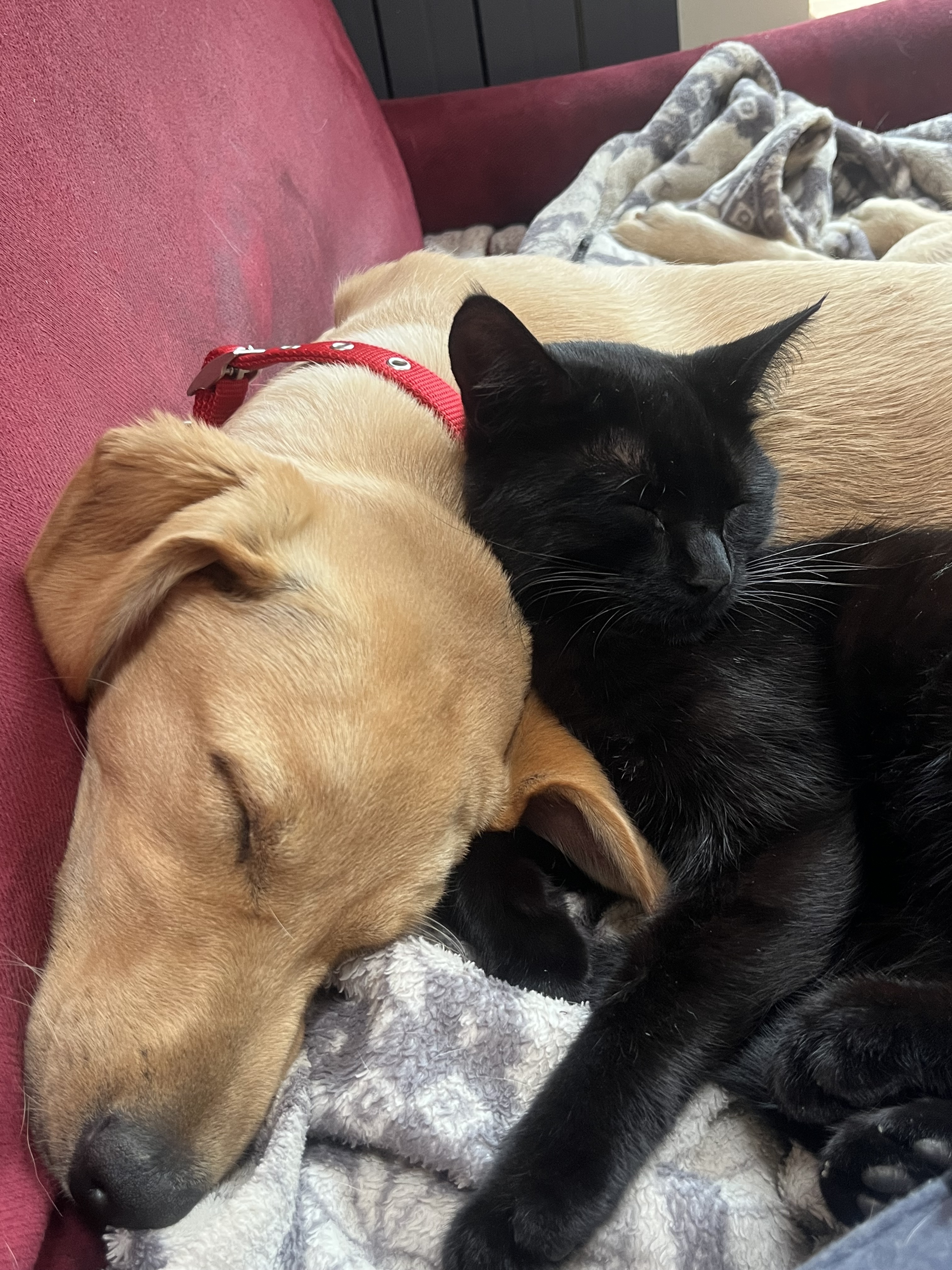
We have a 5 month old puppy who came to us via an amazing local rescue. He is a labradoodle, although he looks and acts far more Labrador than poodle. He gets on well with our older lab, Ned, he is best buddies with our rescue cat, Salem, and even gets on with the rescue ponies (there seems to be a rescue theme here!).

Image description: Labradoodle puppy lying on a grey and white fleece on a red sofa with a black cat lying next to him

He runs, jumps, plays, sleeps (occasionally), torments the cat and sits and cries where we hang up his lead when it’s time for a walk. He’s just started puppy classes, and, hopefully, in about 6 weeks, he should a have his Kennel Club Good Citizen Scheme puppy certificate. Once he has this, we will then work towards bronze and maybe silver and gold, but one step at a time.

He loves walks and going on adventures. He wants to say hello to every person and every dog that we pass. He LOVES water, so we try and choose walks that include a stream to paddle in. He has a penchant for plants, and is often seen with muddy paws and an empty plant pot in his mouth. He loves carrying clothes, and if we ignore him, he runs upstairs to see if there is anything that hasn’t been put away that he can bring down to us. This has included socks, T-shirts, my work fleece and a pair of jeans!

So what has this got to do with different not less?

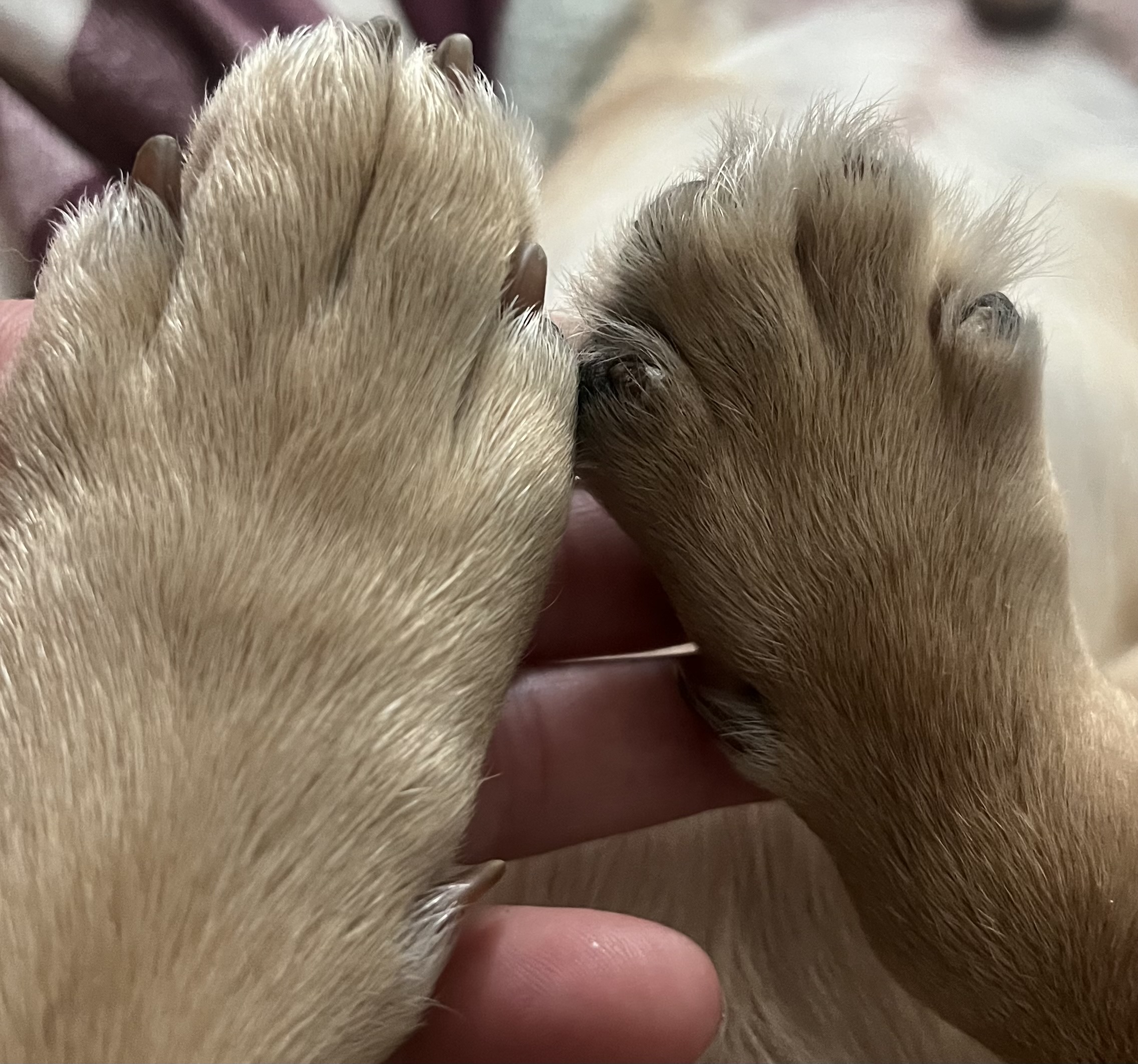
He has a different anatomy to most dogs. His right front leg is twisted, and is smaller than his left leg. He had x-rays when he was with the rescue, and it’s something he was born with. His shoulder blade is normal, and then from his elbow it all goes a bit wonky. When he walks, he walks with a limp as his front limbs are different sizes but when he runs, he hops and looks just like any other dog. His right paw is noticeably smaller than his left.

Image description: two front paws of a labradoodle puppy. The left is the expected size for a 5 month old puppy but the right paw is significantly smaller

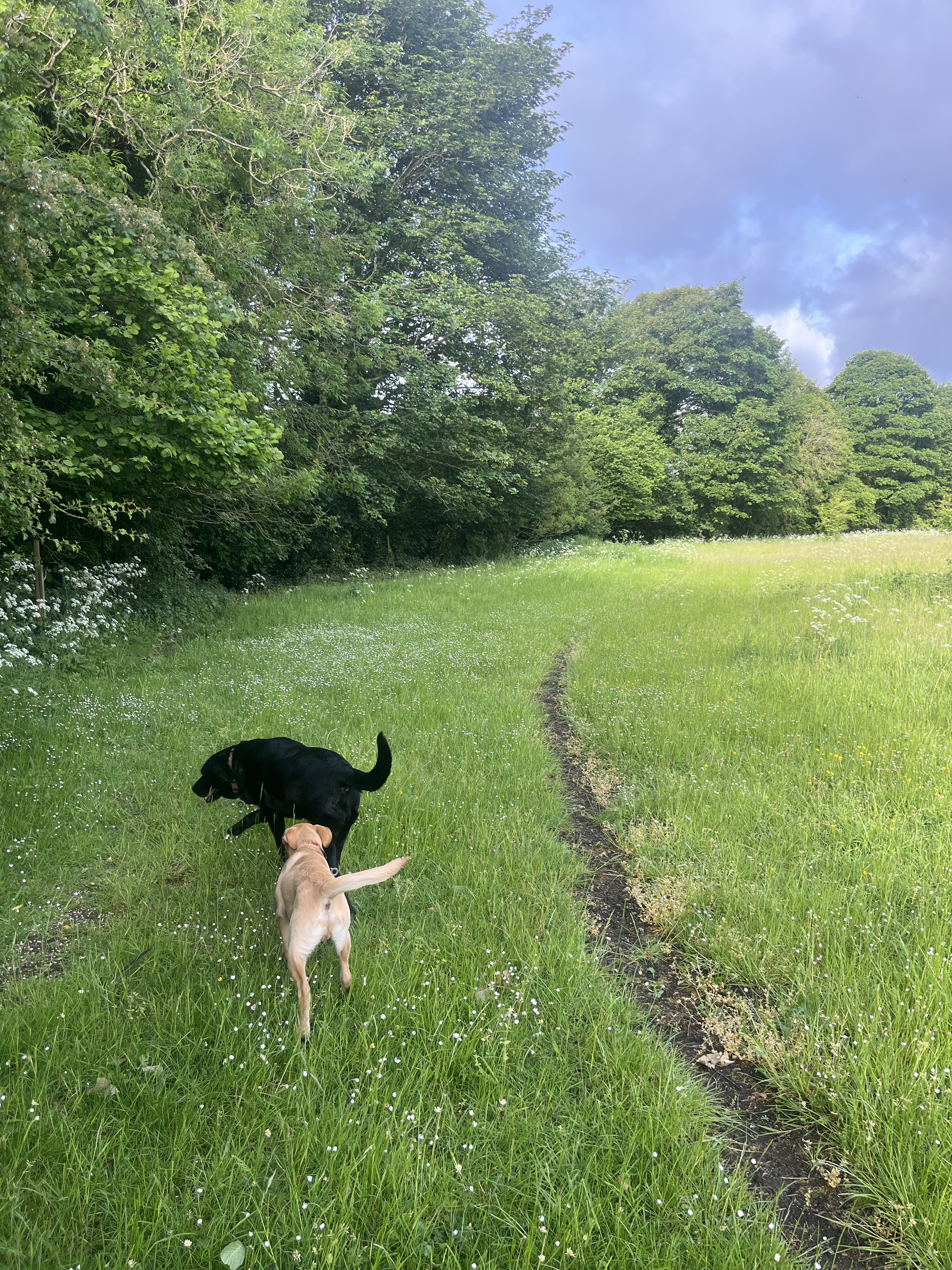
We know that at some point in the future, he may have to have the leg amputated – but he might not. We have spoken at length to the rescue and to our vets, and we are treating him like any other 5 month old puppy. We don’t walk him too far, but at home he has as much free exercise as he wants. He is walked off the lead in the field every morning and afternoon so he can choose if he wants to walk, run, chase Ned or just potter by my side (FYI it’s usually chase Ned).

Image description: a yellow labradoodle puppy chasing a black Labrador in a field. There are trees along the left side of the picture, they are running on grass and daisies. The sky has grey clouds.

At the moment, there isn’t anything that is dis-abled about him. He jumps over chairs, he climbs onto and off the table if there’s a chair close by. He digs holes, he chases the cat, he runs up and down stairs, he runs off with stolen treasures. His anatomy may be a little different, but he is not less, and he is no less able than any other puppy of the same age. We have never said ‘I don’t think he could manage that’ but we have listened to him. When he first arrived, climbing the hill in our garden was hard work, so we let him take the time he needed. His muscles got stronger, and within a week he was running up and down it.

He is different, not less. This is something we need to remember we when look at our square pegs, and maybe we need to remind others that they may be a little different to what we were expecting, but they are definitely not less, and not dis-abled.

DIscovering me

On the 1st March 2025, I was officially diagnosed with ADHD. I was 53 and 3 weeks old.

I knew I was, deep down, but there was still doubt. I self diagnosed a few years ago when we were going through diagnoses with our children, but I didn’t tell anyone that I thought I was for ages, as I felt like a fraud. I was jumping on their bandwagon. I couldn’t have ADHD as I was a woman in my 40s. I was just a bit scatty, very messy, had lots of hobbies that I’d started and then got distracted, often felt like I didn’t belong, and the fact that I left everything until the deadline panic hit was because I was lazy.

In January 2024, inspired by a friend who had been diagnosed as an adult and had found it liberating, I spoke to my GP and then the practice mental health nurse, and using NHS ‘Right to Choose’ I was referred to Psychiatry UK and put on their waiting list (I wrote about this last year, to read the post click here). Just over 13 months after my appointment with the nurse, I had my assessment online.

I didn’t know what to expect, which sounds still as, at his request, I sat in with our youngest when he had his assessment. I was really nervous. The doctor was nice, tried to put me at ease, and then he started asking questions. Some of my answers surprised me – one was about how I did at school and in later education. I can’t fail, and I won’t fail. This isn’t because I’m a genius, it’s because I can’t. If I think I’m going to fail, I quit. And if I do a course, I have to do my absolute best and come as close to the top of the class as I can. If I can’t do well, I won’t do. The doctor seemed very interested in that!

Another question I remember clearly was what would I do if all the things on my to do list were completed. If I woke up tomorrow without any spinning plates (my words here, not his), without anything I wanted or needed to do, how would I feel.

I panicked.

I could not (and cannot) imagine having nothing to do.

I must have looked terrified as I stuttered ‘I don’t know. I have no idea. I can’t begin to imagine what that would be like’ as he told me not to worry and we’d move onto another question.

At the end of the assessment, he told me that there is no doubt whatsoever, I have ADHD. The assessment ended, I told my family, and then I went and curled up on my bed, and I cried.

I cried for the 14 year old me who watched the popular girls at school in awe, not knowing how to be like that. I cried for the younger me who always felt like an outsider. I cried for the me who couldn’t get her written work to match her classroom knowledge. I cried for me now, only just beginning to understand that I was never broken, I wasn’t an alien, and I was always enough.

Eight weeks on, and I’m still doing lots of self-reflection. I’m now seeing where I have masked and camouflaged, and I’m still not entirely sure how I can free myself of masking – and I’m pretty sure I will always camouflage and mirror, especially in social situations.

I don’t necessarily wish I’d gone for diagnosis earlier as I am happy with where I am and who I am, and even if I did regret, it wouldn’t change anything. However, I wish I could go back and hug my younger self and tell me it will all be ok. I also wish I could go back to when our children were little and realise that the behaviour I saw as normal wasn’t normal for everyone. It’s hard to see atypical behaviour when in your world it’s typical. But I didn’t know then, and I have to forgive myself.

This brings me to getting a little political. In a week when RFK Jr has talked so negatively about autism in the US, and Farage as spoken about over diagnosis in the UK, it’s important to remember that there hasn’t been a huge increase in neurodivergent conditions, we’re just beginning to see them. When I was at school in the 1980s, nobody talked about ADHD, and it definitely wasn’t something that would affect an academic, well-behaved girl, so I was missed. There is a meme on social media saying that before 1930, nobody knew about Pluto – but it was still there! It didn’t suddenly appear, it just hadn’t been seen or discovered. It’s the same with ND conditions. And as they usually have a genetic link, quite often a child is diagnosed, and then the parent(s) have a lightbulb moment, and also get assessed – and then you look at other members of the family who were seen as being a bit ‘quirky’, and suddenly it all makes sense.

ADHD, Autism and other ND conditions are not diseases, they are not caused by vaccines, they are not caused by chemtrails or anything else like that. They are a different way of thinking, being and processing. We are different, not less. We have been here since our ancestors came out of Africa, and probably before that. We’re just not hiding any more.

I’m back!!

I really enjoy blogging – I find it cathartic and a positive way to connect with people. When I blog regularly (or semi-regularly) it helps me manage my mental health, and from the comments and messages I get, it helps some of you as well. But sometimes life gets in the way, and then the habit of blogging slips. When I get out of the habit, it feels like it’s been ages since I wrote anything, so I put it off for another week, and another week, and then life gets in the way again, and then here we are, almost a year since I last wrote anything.

My hope is that I will spend Sunday mornings when it’s just me and the dogs awake to write – I’m not promising a blog post every week as I have other writing projects I’d like to get started, but most weeks (fingers crossed).

So, what’s been going on since last May? Well, I officially have ADHD – I had my appointment on the 1st March, and it was quite an emotional hour but at the end I was told that I definitely have ADHD. The relief was huge, and the mental and emotional rollercoaster since then has been a little turbulent, but worth it. I’ll write more about this and the impact it’s had on my well being in my next blog post.

My research has finally got ethics approval, so this starts in about 3 weeks, which is incredibly exciting. To think that 3 years ago I didn’t know about the EdD program at the University of Sheffield, and now I’m coming to the end of the third academic year, about to start interviewing and talking to participants, and within 18 months I could (although it may take longer) have a finished thesis. Exciting but very busy times lie ahead.

Thing 1 and Thing 2 have both had other diagnoses in the last year – both are ASD and ADHD although they both present very differently, which is no surprise. I think it’s been a relief to both of them to know that what they suspected was right, and that the missing pieces in their understanding of themselves are now there, more or less. Diagnoses are there to help us understand ourselves better, as well as for others to understand. If we struggle to know who we are and how we function, it becomes hard to advocate for ourselves – another future post will look into this in more detail.

I want to build Skware Peg as a community for anyone who feels that they don’t quite belong withing societal expectations. Diagnoses are not needed, and I want this to be an accepting, safe place for everyone – especially with what’s happening in the US, and to a lesser extent in the UK.

If you have any suggestions for future posts, please message or comment.

And now it’s my turn

I am 52 years old, and I have always felt like I was on the outside looking in. Unless I am really comfortable in your company, I feel awkward in social situations. I am so messy, I go from one hobby to another, I lose my keys, bag, glasses, phone on an almost hourly basis (and I regularly look for my phone while talking to someone on said phone) and I never feel that I am enough, or that I do enough.

Don’t get me wrong, I have self confidence & self belief. I know my value, and I know that I am good at my job, that I can do almost anything I put my mind to, and I am a fixer (clothes, fencing, DIY, people…), but I often feel that I am different. It’s my normal, and I just thought it was one of those things. Then I had children who ended up being diagnosed with ADHD, ASD and dyslexia and I started to wonder. Both of them are now seeking adult diagnoses for other conditions, and I felt that, ever so slowly, that maybe, just maybe, there was a reason that I felt how I felt.

I read lots of articles, looked into the epigenetic basis for neurodivergences, and so I started saying ‘I think I have ADHD’. That felt ok, I didn’t feel like a fraud, so then I said I was self diagnosed with ADHD. Again, it felt ok. However, it still didn’t feel enough. Some people raised an eyebrow, but I am my own worst critic. On dark days, I doubted self diagnosing. I felt I was just making excuses for a messy house, for not completing tasks, for feeling overwhelmed with life, for having a burn out day. Self diagnosis wasn’t enough. I needed to do more.

Inspired by my children, I did a few more online assessments, and then I emailed the GP. I had a phone consultation with the mental health nurse, and then through NHS Right to Choose, I was referred to Psychiatry UK back in January.

I heard nothing, so my self doubt came back. Maybe I didn’t have enough symptoms to be referred, maybe it was all just in my head and I was just a very a scatty messy person. I messaged the GP admin people who said they would look into it, and still I heard nothing.

And then today, I had several emails, one of which contained the following sentence:

Great news! We have reviewed and accepted your referral for your ADHD assessment.

I almost cried. My referral has been accepted. I am going to get an ADHD assessment. I am not broken. I am finally going to get an answer.

I read the following poem recently on Insta, it’s by Jessica Jocelyn (letters.to.anna on Insta), and it sums it all up so well.

behind every late diagnosed woman

is a little girl

who knew this world

was never made for her

but could never explain why.

I have supported my children through their battles, and I will continue to do so, but now it’s my turn. I need to support myself, I need to be kind to myself, and I need to battle for myself as I have battled for everyone else.

It’s my turn now.

And now it’s my turn.

I advocate for people, I tell parents how a diagnosis is a lens not a label and it allows children to be seen and understood. I tell them that the ADHD/ASD is always there, it’s just a diagnosis opens a door to understanding and help. And yet when it came to me….

I self diagnosed with ADHD several years ago – part of the reason why we didn’t look for an ADHD/ASD diagnosis when our children were young as we didn’t really see anything different about how they behaved or learned. They may have been a little more intense than we were as children, but the things I used to do (pluck quilts, draw on anything, take things to bits, climb anything and I was a rubbish sleeper) and to some extent still do (although I’ve only ever plucked on feather quilt) were pretty much what our children did.

So why only self diagnosis? Maybe because ADHD wasn’t a thing when I was growing up, especially not for girls. Looking back at my school reports that frequently talked about how good I was in the classroom but how my homework and written work didn’t quite match, and how I could be argumentative and was good at debates, or thinking about how I used to be dared to distract the English teacher on Friday afternoons in 6th form so we could have a discussion rather than a lesson, it’s clear that the signs were there at school as well as at home.

But it just wasn’t a thing – and I did well in education. I passed all my GCSEs and A-levels, even if my grades were not as good as predicted. I then decided not to go to university at 18, and several jobs before getting married and then having our eldest. I went to uni as a mature student with a toddler who didn’t sleep, a husband who worked long hours, a night sitting care job 2 nights a week and an hour commute to university. Spinning plates is a understatement, but my hyperfocused mind just did what it needed to do, and I graduated top of my class.

When I started teaching, I taught whatever I was asked to teach, and I was good at it – I’m still in contact with so many students (hello if you’re reading this), and I did my teacher training while I was teaching (which is common in colleges). I then started a part time Masters degree while teaching and co-running a business and now with a toddler and a 10 year old, neither of whom slept. Spinning more plates, but I did it, and came top of my class again.

The more I have to do, the more I thrive. Today I am a curriculum lead in a small special school, I blog, I have written & self published my first book, and am now working on a book proposal to traditionally publish my second. I live on a small holding and my husband and I are setting up a brewery. We still have our family IT business and I do the accounts for that. Our youngest is struggling with uni life so I am on tram transport 2 or 3 days a week. And on top of all that, I’m doing a self funded part time doctorate. Spinning plates – again!

So what gives? Well, I’m messy. Our house is never spotless, and is often verging on feral. I have so many unfinished books and crafting projects (because I need to have a hobby on top of everything else) and sometimes – probably much more often that I think – I am grumpy and moody.

So, yeah. Self diagnosed ADHD, but I say it almost as a joke.

Not any more. A couple of weeks ago, after helping our youngest fill out his form/test for ADHD referral, I decided to take the test myself. On the ADHD Self Report Scale (ASRS v1.1) Symptom Checklist there are 18 questions. I answered honestly, and I ticked 17 out of the 18 boxes.

I decided self diagnosis wasn’t enough but I know that our GPs our incredibly busy, and I didn’t want to take up an appointment, so I emailed saying that I thought I might be ADHD, and could I maybe talk to someone about the possibility of maybe getting a referral. I tried to make it as ‘sorry to bother you and don’t worry if I can’t’ kind of language.

A text came back within an hour offering me an appointment with the mental health nurse. I felt a huge weight start to lift off my shoulders. Unfortunately the first appointment was cancelled because the nurse was ill. I had the phone call at work, and I cried on the way home. That weight of spinning plates was pressing on my shoulders again. I only had to wait 2 weeks for the new appointment, but it felt like I was going to be waiting for ages.

I had my appointment last night, and yes, I am going to be referred for ADHD diagnosis. When I was talking to the nurse, I said (without thinking) that I wanted a diagnosis so that I could be kinder to myself, and that’s the main reason why I am now on the waiting list. I need to be kinder to myself. I have an amazing brain that does amazing things and is excellent at spinning plates, but I don’t see the mess on the floor, and I have just remembered as I type that there’s a washing machine full of washing that was supposed to go on the line this morning before I left the house. Oops. I am also brilliant at choosing and writing cards, but then finding them weeks later unposted. I start craft projects all the time and if I don’t finish them before I get bored, I just leave them and start something new.

But it’s ok. It’s how I’m wired. And now I have finally taken my own advice, I have made that call, and I am on the waiting list.

Now it’s my turn.

When Anxiety Comes Knocking

Nobody chooses to have anxiety. I’m not talking about that anxious feeling you might get before flying or before an exam. Instead, I mean general anxiety, where you overthink most things and live in a state of heightened angst and awareness most of the time.

Our youngest is back at uni tomorrow. He has mixed feelings. He’s looking forward to a more ‘him’ mix of modules this semester, but he’s also very anxious because it’s a new timetable, new lectures, possible new lecturers and, unlike many of his peers, he’s at uni 5 days a week.

Because uni has been harder than any of us anticipated, he has taken steps to keep his anxiety under control, and as I wrote last week, he has been to see the GP, mental health nurse and then therapist, and CBT will continue this coming week.

What we all need to remember, is that anxiety is not a choice. Like depression and other mental health issues, anxiety is not something you can change with a positive mental attitude or by simply stopping worrying. And anxiety can cause ripples that make other things less bearable.

If I am anxious, I get more jumpy, more stressed and my eating patterns change (either increasing or decreasing). I also get palpitations, and I sometimes get IBS symptoms. Anxiety causes an increase in cortisol, and our bodies go into fight, flight or freeze mode. Anxiety is a throw back to our hunter gatherer ancestors. Going into survival mode when predator was close, or when you travelled to a new area where there may be unknown dangers meant you were more likely to survive. Going into survival mode because there is a stressor you cannot control in the 21st Century means that our busy modern lives may be impacted.

There are lots of things we can do when we feel anxious. Being outside, going for walks, and being near animals may help, as can yoga, controlled breathing, mindfulness, grounding and similar activities. I find playing loud music and screaming (or swearing) really loud whilst driving in the middle of nowhere very cathartic and it definitely helps to relieve short term anxiety and stress, but it’s not something my vocal chords could manage on a daily basis!

So, what do we do when anxiety comes calling? If possible, we remove the stressor(s), but this is not always possible. We use different techniques and activities, we talk to health care professionals, we take medication (if appropriate or advised) and we take each day at a time. We also need to be honest and talk to people we trust about what’s going on. As I wrote last week, mental health is health, and we need to talk more about how we are feeling. I write in my book (available here) about how we need a tribe, a circle of friends – or even just one or two people – who we can turn to and who will listen.

As the saying goes, a problem shared is a problem halved. Talking to someone you trust really can make a huge difference. If there isn’t anyone you can talk to, then you can contact your GP, you can self refer to talking therapy services through the NHS, and you can talk to the Samaritans, the NHS Crisis line, and other organisations. The list below is listed directly from the MIND website – link here – but remember anxiety can affect any of us, and you don’t need to be alone.

Urgent mental health helpline

England

If you live in England, you can call a local NHS urgent mental health helpline for support during a mental health crisis. Anyone can call these helplines, at any time.

These helplines offer similar support to a crisis team. The NHS website has more information on urgent mental health helplines, including how to find your local helpline.

Wales

In Wales, you can contact NHS 111 and select option 2. This will put you through to an NHS helpline offering 24/7 urgent mental health support. Visit the NHS 111 Wales website to find out more about this service.